

Vol. 12. Núm. 39.
Páginas 2299-2308 (Septiembre 2017)

Actualización
Fibrilación auricular y flúter auricular

Atrial fibrillation and atrial flutter

M. Valverde GómezC. Lozano GraneroD. Rodríguez MuñozJ.L. Zamorano Gómez
Doi : https://10.1016/j.med.2017.07.010
Opciones
Resumen
Introducción

La fibrilación auricular es la arritmia sostenida más frecuente, con una incidencia del 3% en la población general, aunque con una prevalencia mayor en la población de edad avanzada, hipertensos, obesos y pacientes con cardiopatía estrucutural.

Diagnóstico

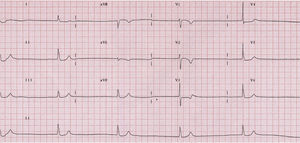
El diagnóstico electrocardiográfico se basa en la identificación del patrón R-R irregularmente irregular característico. Como parte del estudio, es conveniente la realización de un ecocardiograma transtorácico que nos permita diagnosticar la presencia de cardiopatía estructural y valorar el tamaño auricular, importante de cara a plantear un procedimiento de ablación, y una analítica completa con perfil tiroideo, para así descartar otras causas desencadenantes como la anemia, la infección o el hipertiroidismo.

Manejo

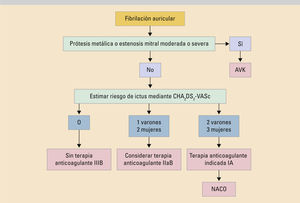
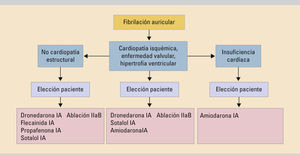
El manejo de esta patología se fundamenta en tres pilares: la terapia antitrombótica para la prevención del embolismo sistémico y los accidentes cerebrovasculares, de actualidad en los últimos años gracias a la aparición de alternativas orales a la terapia anticoagulante clásica con antagonistas de la vitamina K; el control de la frecuencia cardíaca con fármacos frenadores, especialmente bloqueadores betaadrenérgicos, aunque también calcioantagonistas y digoxina, y las estrategias de control de ritmo, tanto farmacológicas como percutáneas, estas últimas cada vez más extendidas debido a su mayor efectividad y baja incidencia de complicaciones.

Palabras clave
Fibrilación auricular
Flúter auricular
Riesgo trombótico
Nuevos anticoagulantes orales
Ablación con radiofrecuencia
Abstract
Introduction

Atrial fibrillation is the most frequent sustained arrhythmia, with a prevalence of 3% in the general population, although with a higher prevalence in the elderly, hypertensive, obese and patients with structural heart disease.

Diagnosis

The electrocardiographic diagnosis is based on the identification of the irregularly irregular pattern R-R characteristic. As part of the study, it is convenient to perform a transthoracic echocardiogram, which allows us to diagnose the presence of structural heart disease and to assess the atrial size, which is important for an ablation procedure, and a complete analysis with a thyroid profile, in order to rule out Other triggers, such as anemia, infection, or hyperthyroidism.

Management

The management of this pathology is based on three pillars: antithrombotic therapy for the prevention of systemic embolism and cerebrovascular accidents, current in recent years thanks to the appearance of oral alternatives to classical anticoagulant therapy with vitamin antagonists K; Heart rate control with braking agents, especially beta-adrenergic blockers, but also calcium-antagonists and digoxin; And rhythm control strategies, both pharmacological and percutaneous, the latter increasingly widespread due to its greater effectiveness and low incidence of complications.

Keywords
Atrial fibrillation
Atrial Flutter
Thrombotic risk
New oral anticoagulants
Ablation with radiofrequency

Identifíquese

¿Aún no es suscriptor de la revista?

Comprar el acceso al artículo

Comprando el artículo el pdf del mismo podrá ser descargado

Teléfono para incidencias

De lunes a viernes de 9h a 18h (GMT+1) excepto los meses de julio y agosto que será de 9 a 15h

Llamadas desde España 932 415 960
Llamadas desde fuera de España +34 932 415 960
Bibliografía
[1]
201709010036585498
201709010036585499
S. Björck, B. Palaszewski, L. Friberg, L. Bergfeldt.
Atrial fibrillation, stroke risk, and warfarin therapy revisited: A population-based study.
Stroke., (2013), 44 pp. 3103-3108
[2]
2017090100365854910
2017090100365854911
S.S. Chugh, R. Havmoeller, K. Narayanan, D. Singh, M. Rienstra, E.J. Benjamin.
Worldwide epidemiology of atrial fibrillation: A global burden of disease 2010 study.
Circulation., (2014), 129 pp. 837-847
[3]
2017090100365854912
M. Zoni-Berisso, F. Lercari, T. Carazza, S. Domenicucci.
Epidemiology of atrial fibrillation: European perspective.
Clin Epidemiol., (2014), 6 pp. 213-220
[4]
2017090100365854913
2017090100365854914
D.M. Lloyd-Jones, T.J. Wang, E.P. Leip, M.G. Larson, D. Levy, R.S. Vasan, et al.
Lifetime risk for development of atrial fibrillation: The framingham heart study.
Circulation., (2004), 110 pp. 1042-1046
[5]
2017090100365854915
S. Stewart, C.L. Hart, D.J. Hole, J.J.V. Mcmurray.
a population-based study of the long-term risks associated with atrial fibrillation: 20-year follow-up of the Renfrew/Paisley Study.
Am J Med., (2002), 113 pp. 359-364
[6]
2017090100365854916
T. Andersson, A. Magnuson, I.L. Bryngelsson, O. Frøbert, K.M. Henriksson, N. Edvardsson, et al.
All-cause mortality in 272 186 patients hospitalized with incident atrial fibrillation 1995-2008: A Swedish nationwide long-term case-control study.
Eur Heart J., (2013), 34 pp. 1061-1067
[7]
2017090100365854917
F. García Cosío, A. Pastor, A. Núñez, A.P. Magalhaes, P. Awamleh.
Flúter auricular: perspectiva clínica actual.
Rev Española Cardiol., (2006), 59 pp. 816-831
[8]
2017090100365854918
A. Frustaci, C. Chimenti, F. Bellocci, E. Morgante, M.A. Russo, A. Maseri.
Histological substrate of atrial biopsies in patients with lone atrial fibrillation.
Circulation., (1997), 96 pp. 1180-1184
[9]
2017090100365854919
N. Voigt, J. Heijman, Q. Wang, D.Y. Chiang, N. Li, M. Karck, et al.
Cellular and molecular mechanisms of atrial arrhythmogenesis in patients with paroxysmal atrial fibrillation.
Circulation., (2014), 129 pp. 145-156
[10]
2017090100365854920
M. Allessie, J. Ausma, U. Schotten.
Electrical, contractile and structural remodeling during atrial fibrillation.
Cardiovasc Res., (2002), 54 pp. 230-246
[11]
2017090100365854921
2017090100365854922
S. Benussi.
ESC Guidelines for the management of atrial fibrillation developed in collaboration with EACTS.
Eur Heart J. En prensa, (2016), pp. 2017
[12]
A. Fontenia Cerezuela, M. López Gil, R. Salguero Bodes, F. Arribas Ynsaurriaga.
Flúter auricular y otras taquiarritmias auriculares macroreentrantes.
Manual de arritmias y electrofisiología cardíaca., Pulso Ediciones, pp. 232-249
[13]
2017090100365854923
E.J. Benjamin, P.A. Wolf, R.B.D. Agostino, H. Silbershatz, W.B. Kannel, D. Levy.
Clinical investigation and reports impact of atrial fibrillation on the risk of death The Framingham Heart Study.
Circulation., (1998), 98 pp. 946-953
[14]
2017090100365854924
A. Manuscript.
Nanostructures SPC. NIH Public Access.
Nano., (2008), 6 pp. 2166-2171
[15]
2017090100365854925
G.J. Wynn, D.M. Todd, M. Webber, et al.
The European Heart Rhythm Association symptom classification for atrial fibrillation: Validation and improvement through a simple modification.
Europace., (2014), 16 pp. 965-972
[16]
O.J. Ziff, D.A. Lane, M. Samra, M. Griffith, P. Kirchhof, G.Y. Lip, et al.
Safety and efficacy of digoxin: systematic review and meta-analysis of observational and controlled trial data.
BMJ., (2015), 351
h4451
[17]
2017090100365854926
2017090100365854927
D. Kotecha, J.P. Piccini.
Atrial fibrillation in heart failure: What should we do?.
Eur Heart J., (2015), 36 pp. 3250-3257
[18]
2017090100365854928
A.J. Manolis, E.A. Rosei, A. Coca, et al.
Hypertension and atrial fibrillation.
J Hypertens., (2012), 30 pp. 239-252
[19]
2017090100365854929
R. Nieuwlaat, A. Capucci, A.J. Camm, S.B. Olsson, D. Andresen, D.W. Davies, et al.
Atrial fibrillation management: A prospective survey in ESC Member Countries - The Euro Heart Survey on atrial fibrillation.
Eur Heart J., (2005), 26 pp. 2422-2434
[20]
2017090100365854930
R. De Caterina, A.J. Camm.
What is “valvular” atrial fibrillation?. A reappraisal.
Eur Heart J., (2014), 35 pp. 3328-3335
[21]
2017090100365854931
H.S. Abed, G.A. Wittert, D.P. Leong, M.G. Shirazi, B. Bahrami, M.E. Middeldorp, et al.
Effect of weight reduction and cardiometabolic risk factor management on symptom burden and severity in patients with atrial fibrillation.
[22]
2017090100365854932
G.Y.H. Lip, R. Nieuwlaat, R. Pisters, D.A. Lane, H.J.G.M. Crijns.
Refining clinical risk stratification for predicting stroke and thromboembolism in atrial fibrillation using a novel risk factor-based approach: The Euro Heart Survey on atrial fibrillation.
Chest., (2010), 137 pp. 263-272
[23]
2017090100365854933
R. Pisters, D.A. Lane, R. Nieuwlaat, C.B. De Vos, H.J.G.M. Crijns, G.Y.H. Lip.
A novel user-friendly score (HAS-BLED) to assess 1-year risk of major bleeding in patients with atrial fibrillation: The euro heart survey.
Chest., (2010), 138 pp. 1093-1100
[24]
2017090100365854934
V.Y. Reddy, S.K. Doshi, H. Sievert, M. Buchbinder, P. Neuzil, K. Huber, et al.
Percutaneous left atrial appendage closure for stroke prophylaxis in patients with atrial fibrillation 2.3-year follow-up of the PROTECT AF (Watchman left atrial appendage system for embolic protection in patients with atrial fibrillation) trial.
Circulation., (2013), 127 pp. 720-729
[25]
2017090100365854935
H. Heidbuchel, P. Verhamme, M. Alings, M. Antz, H.C. Diener, W. Hacke, et al.
Updated European Heart Rhythm Association Practical Guide on the use of non-Vitamin K antagonist anticoagulants in patients with non-valvular atrial fibrillation.
Europace., (2015), 17 pp. 1467-1507
[26]
2017090100365854936
H.F. Groenveld, H.J.G.M. Crijns, M.P. Van Den Berg, E. Van Sonderen, A.M. Alings, J.G. Tijssen, et al.
The effect of rate control on quality of life in patients with permanent atrial fibrillation: Data from the race II (Rate Control Efficacy in Permanent Atrial Fibrillation II) study.
J Am Coll Cardiol., (2011), 58 pp. 1795-1803
[27]
2017090100365854937
T. Nikolaidou, K.S. Channer.
Chronic atrial fibrillation: a systematic review of medical heart rate control management.
Postgrad Med J., (2009), 85 pp. 303-312
[28]
2017090100365854938
M.P. Turakhia, P. Santangeli, W.C. Winkelmayer, X. Xu, A.J. Ullal, C.T. Than, et al.
Increased mortality associated with digoxin in contemporary patients with atrial fibrillation: findings from the TREAT-AF study.
J Am Coll Cardiol., (2014), 64 pp. 660-668
[29]
2017090100365854939
P. Ponikowski, A.A. Voors, S.D. Anker, H. Bueno, J.G. Cleland, A.J. Coats, et al.
2016 ESC Guidelines for the diagnosis and treatment of acute and chronic heart failure.
Eur Heart J., (2016), 37 pp. 2129-2200
[30]
2017090100365854940
K. Vijayalakshmi, V.J. Whittaker, A. Sutton, P. Campbell, R.A. Wright, J.A. Hall, et al.
A randomized trial of prophylactic antiarrhythmic agents (amiodarone and sotalol) in patients with atrial fibrillation for whom direct current cardioversion is planned.
Am Heart J., (2006), 151 pp. 2-7
[31]
2017090100365854941
J. Reisinger, E. Gatterer, G. Heinze, K. Wiesinger, E. Zeindlhofer, M. Gattermeier, et al.
Prospective comparison of flecainide versus sotalol for immediate cardioversion of atrial fibrillation.
Am J Cardiol., (1998), 81 pp. 1450-1454