

Vol. 14. Núm. 44.
Páginas 2631-2637 (Noviembre 2025)

Protocolos de práctica asistencial
Protocolo terapéutico de la antiagregación y la anticoagulación en la cardiopatía isquémica

Treatment protocol for antiplatelet therapy and anticoagulation in ischemic heart disease

B. Álvarez ÁlvarezJ. Martinón MartínezR.M. Agra BermejoD. Iglesias ÁlvarezP. Rigueiro VelosoJ.M. García AcuñaJ.R. González Juanatey
Doi : https://10.1016/j.med.2025.11.006
Opciones
Resumen

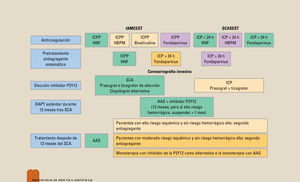
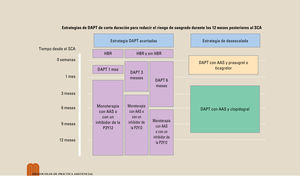
El protocolo terapéutico para la terapia antiplaquetaria y anticoagulante en la enfermedad arterial coronaria incluye la administración de terapia dual antiplaquetaria (DAPT) con ácido acetilsalicílico (AAS) y un inhibidor del receptor P2Y12 (clopidogrel, prasugrel o ticagrelor), durante al menos 12 meses tras un síndrome coronario agudo (SCA). La duración de la DAPT debe ajustarse según el riesgo de sangrado del paciente, siguiendo las recomendaciones de la ACC/AHA. Para pacientes con alto riesgo de sangrado, definido por una puntuación PRECISE-DAPT igual o superior a 25, se puede considerar una duración más corta de DAPT (3-6 meses). En pacientes con bajo riesgo de sangrado y alto riesgo isquémico, se puede considerar prolongar la DAPT más allá de los 12 meses, aunque la duración óptima no está bien establecida. El uso de inhibidores más potentes como prasugrel y ticagrelor está recomendado en pacientes sin contraindicaciones específicas, como antecedentes de accidente cerebrovascular o edad avanzada. En pacientes con alto riesgo de sangrado, la desescalada a clopidogrel o la transición a monoterapia con un inhibidor P2Y12 después de 1-3 meses puede ser razonable. Mención especial deben recibir los pacientes con necesidad de anticoagulación crónica, debido al incremento del riesgo de sangrado que se debe tener en cuenta. En la mayoría de estos casos, el inhibidor del receptor P2Y12 de elección será clopidogrel.

Palabras clave
Riesgo isquémico
Riesgo hemorrágico
Inhibidores del P2Y12
Ácido acetilsalicílico
Anticoagulación oral
Abstract

The treatment protocol for antiplatelet and anticoagulant therapy in coronary artery disease includes the administration of dual antiplatelet therapy (DAPT) with acetylsalicylic acid (ASA) and a P2Y12 receptor inhibitor (clopidogrel, prasugrel, or ticagrelor) for at least 12 months after an acute coronary syndrome (ACS). The duration of DAPT should be adjusted according to the patient's bleeding risk, following ACC/AHA recommendations. For patients at high bleeding risk, defined as a PRECISE-DAPT score equal to or greater than 25, a shorter duration of DAPT (3–6 months) can be considered. In patients with low bleeding risk and high ischemic risk, prolonging DAPT beyond 12 months can be considered, although the optimal duration is not well established. The use of more potent inhibitors such as prasugrel and ticagrelor is recommended in patients without specific contraindications, such as a history of stroke or advanced age. In patients at high bleeding risk, de-escalation to clopidogrel or switching to monotherapy with a P2Y12 inhibitor after 1–3 months may be reasonable. Patients who require chronic anticoagulation merit special mention due to the increased risk of bleeding that must be taken into account. In most of these cases, the P2Y12 receptor inhibitor of choice will be clopidogrel.

Keywords
Ischemic risk
Bleeding risk
P2Y12 inhibitors
Acetylsalicylic acid
Oral anticoagulation

Identifíquese

¿Aún no es suscriptor de la revista?

Comprar el acceso al artículo

Comprando el artículo el pdf del mismo podrá ser descargado

Teléfono para incidencias

De lunes a viernes de 9h a 18h (GMT+1) excepto los meses de julio y agosto que será de 9 a 15h

Llamadas desde España 932 415 960
Llamadas desde fuera de España +34 932 415 960
Bibliografía
[1]
R.A. Byrne
202511280532465828
, X. Rossello, J.J. Coughlan, E. Barbato, C. Berry, A. Chieffo, et al.
ESC Scientific Document Group. 2023 ESC Guidelines for the management of acute coronary syndromes.
Eur Heart J., (2023), 44 pp. 3720-3826
[2]
F.J. Neumann
202511280532465829
, M. Sousa-Uva, A. Ahlsson, F. Alfonso, A.P. Banning, U. Benedetto, et al.
ESC Scientific Document Group. 2018 ESC/EACTS Guidelines on myocardial revascularization.
Eur Heart J., (2019), 40 pp. 87-165
[3]
C. Vrints
2025112805324658210
, F. Andreotti, K.C. Koskinas, X. Rossello, M. Adamo, J. Ainslie, et al.
ESC Scientific Document Group. 2024 ESC Guidelines for the management of chronic coronary syndromes.
Eur Heart J., (2024), 45 pp. 3415-3537
[4]
S. Yusuf
2025112805324658211
, F. Zhao, S.R. Mehta, S. Chrolavicius, G. Tognoni, K.K. Fox.
Clopidogrel in Unstable Angina to Prevent Recurrent Events Trial Investigators. Effects of clopidogrel in addition to aspirin in patients with acute coronary syndromes without ST-segment elevation.
N Engl J Med., (2001), 345 pp. 494-502
[5]
M.S. Sabatine
2025112805324658212
, C.P. Cannon, C.M. Gibson, J.L. López-Sendón, G. Montalescot, P. Theroux, et al.
CLARITY-TIMI 28 Investigators. Addition of clopidogrel to aspirin and fibrinolytic therapy for myocardial infarction with ST-segment elevation.
N Engl J Med., (2005), 352 pp. 1179-1189
[6]
L. Wallentin
2025112805324658213
, R.C. Becker, A. Budaj, C.P. Cannon, H. Emanuelsson, C. Held, et al.
Ticagrelor versus clopidogrel in patients with acute coronary syndromes.
N Engl J Med., (2009), 361 pp. 1045-1057
[7]
S.D. Wiviott
2025112805324658214
, E. Braunwald, C.H. McCabe, G. Montalescot, W. Ruzyllo, S. Gottlieb, et al.
TRITON-TIMI 38 Investigators. Prasugrel versus clopidogrel in patients with acute coronary syndromes.
N Engl J Med., (2007), 357 pp. 2001-2015
[8]
D.L. Bhatt
2025112805324658215
, G.W. Stone, K.W. Mahaffey, C.M. Gibson, P.G. Steg, C.W. Hamm, et al.
CHAMPION PHOENIX Investigators. Effect of platelet inhibition with cangrelor during PCI on ischemic events.
N Engl J Med., (2013), 368 pp. 1303-1313
[9]
R.A. Harrington
2025112805324658216
, G.W. Stone, S. McNulty, H.D. White, A.M. Lincoff, C.M. Gibson, et al.
Platelet inhibition with cangrelor in patients undergoing PCI.
N Engl J Med., (2009), 361 pp. 2318-2329
[10]
J.L. Mega
2025112805324658217
, E. Braunwald, S.D. Wiviott, J.P. Bassand, D.L. Bhatt, C. Bode, et al.
ATLAS ACS 2–TIMI 51 Investigators. Rivaroxaban in patients with a recent acute coronary syndrome.
N Engl J Med., (2012), 366 pp. 9-19
[11]
J.W. Eikelboom
2025112805324658218
, S.J. Connolly, J. Bosch, G.R. Dagenais, R.G. Hart, O. Shestakovska, et al.
COMPASS Investigators. Rivaroxaban with or without aspirin in stable cardiovascular disease.
N Engl J Med, (2017), 377 pp. 1319-1330
[12]
R.P. Giugliano
2025112805324658219
, C.T. Ruff, E. Braunwald, S.A. Murphy, S.D. Wiviott, J.L. Halperin, et al.
ENGAGE AF-TIMI 48 Investigators. Edoxaban versus warfarin in patients with atrial fibrillation.
N Engl J Med., (2013), 369 pp. 2093-2104
[13]
M.R. Patel
2025112805324658220
, K.W. Mahaffey, J. Garg, G. Pan, D.E. Singer, W. Hacke, et al.
ROCKET AF Investigators. Rivaroxaban versus warfarin in nonvalvular atrial fibrillation.
N Engl J Med., (2011), 365 pp. 883-891
[14]
C.B. Granger
2025112805324658221
, J.H. Alexander, J.J. McMurray, R.D. Lopes, E.M. Hylek, M. Hanna, et al.
ARISTOTLE Committees and Investigators. Apixaban versus warfarin in patients with atrial fibrillation.
N Engl J Med., (2011), 365 pp. 981-992
[15]
R.D. Lopes
2025112805324658222
, G. Heizer, R. Aronson, A.N. Vora, T. Massaro, R. Mehran, et al.
AUGUSTUS Investigators. Antithrombotic Therapy after Acute Coronary Syndrome or PCI in Atrial Fibrillation.
N Engl J Med, (2019), 380 pp. 1509-1524
[16]
J.W. Eikelboom
2025112805324658223
, S.J. Connolly, J. Bosch, G.R. Dagenais, R.G. Hart, O. Shestakovska, et al.
Rivaroxaban with or without aspirin in stable cardiovascular disease.
N Engl J Med., (2017), 377 pp. 1319-1330
[17]
S.J. Connolly
2025112805324658224
, J.W. Eikelboom, J. Bosch, G. Dagenais, L. Dyal, F. Lanas, et al.
Rivaroxaban with or without aspirin in patients with stable coronary artery disease: an international, randomised, double-blind, placebo-controlled trial.
Lancet., (2018), 391 pp. 205-218
[18]
L. Mauri
2025112805324658225
, D.J. Kereiakes, R.W. Yeh, P. Driscoll-Shempp, D.E. Cutlip, P.G. Steg, et al.
Twelve or 30 months of dual antiplatelet therapy after drug-eluting stents.
N Engl J Med., (2014), 371 pp. 2155-2166
[19]
M.P. Bonaca
2025112805324658226
, D.L. Bhatt, P.G. Steg, R.F. Storey, M. Cohen, K. Im, et al.
Ischaemic risk and efficacy of ticagrelor in relation to time from P2Y12 inhibitor withdrawal in patients with prior myocardial infarction: insights from PEGASUS-TIMI 54.
Eur Heart. J, (2016), 37 pp. 1133-1142
[20]
M.P. Bonaca
2025112805324658227
, D.L. Bhatt, M. Cohen, P.G. Steg, R.F. Storey, E.C. Jensen, et al.
Long-term use of ticagrelor in patients with prior myocardial infarction.
N Engl J Med., (2015), 372 pp. 1791-1800
[21]
D. Sibbing
2025112805324658228
, D. Aradi, C. Jacobshagen, L. Gross, D. Trenk, T. Geisler, et al.
Guided de- escalation of antiplatelet treatment in patients with acute coronary syndrome undergoing percutaneous coronary intervention (TROPICAL-ACS): a randomised, open- label, multicentre trial.
Lancet., (2017), 390 pp. 1747-1757
[22]
D.M.F. Claassens
2025112805324658229
, G.J.A. Vos, T.O. Bergmeijer, R.S. Hermanides, A.W.J. van’t Hof, P. van der Harst, et al.
A genotype-guided strategy for oral P2Y(12) inhibitors in primary PCI.
N Engl J Med., (2019), 381 pp. 1621-1631
[23]
T. Cuisset
2025112805324658230
, P. Deharo, J. Quilici, T.W. Johnson, S. Deffarges, C. Bassez, et al.
Benefit of switching dual antiplatelet therapy after acute coronary syndrome: the TOPIC (timing of platelet inhibition after acute coronary syndrome) randomized study.
Eur Heart J., (2017), 38 pp. 3070-3078
[24]
C.J. Kim
2025112805324658231
, M.W. Park, M.C. Kim, E.H. Choo, B.-H. Hwang, K.Y. Lee, et al.
Unguided de- escalation from ticagrelor to clopidogrel in stabilised patients with acute myocardial infarction undergoing percutaneous coronary intervention (TALOS-AMI): an investigator-initiated, open-label, multicentre, non-inferiority, randomised trial.
Lancet., (2021), 398 pp. 1305-1316
[25]
H.S. Kim
2025112805324658232
, J. Kang, D. Hwang, J.-K. Han, H.-M. Yang, H.-J. Kang, et al.
Prasugrel-based de- escalation of dual antiplatelet therapy after percutaneous coronary intervention in patients with acute coronary syndrome (HOST-REDUCE-POLYTECH-ACS): an open- label, multicentre, non-inferiority randomised trial.
Lancet., (2020), 396 pp. 1079-1089