

Vol. 14. Núm. 4.
Páginas 175-184 (Marzo 2024)

Actualización
Síndrome de Lynch. Cáncer de colon familiar no sindrómico

Lynch syndrome (hereditary nonpolyposis colon cancer). Nonsyndromic familial colon cancer

M. Sierra MoralesI. Bartolomé OterinoS. Redondo EvangelistaP. García CentenoA. Santos Rodríguez
Doi : https://10.1016/j.med.2024.02.020
Opciones
Resumen

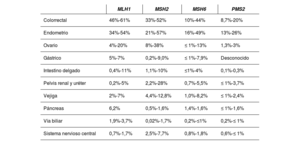
El síndrome de Lynch es el síndrome hereditario de cáncer colorrectal (CCR) más común, siendo respon-sable de un 2%-4% de todos los casos de CCR a nivel global. Sigue un patrón de herencia autosómico dominante y se define por la presencia de una variante patogénica en línea germinal de alguno de los genes que codifican para las proteínas reparadoras del ADN (MMR), MLH1, MSH2, MSH6, PMS2, o en el extremo 3’ del gen EPCAM. Este síndrome condiciona un mayor riesgo de desarrollar CCR y cáncer de endometrio, además de otros tumores. Su diagnóstico se basa en criterios clínicos que tienen en cuenta los antecedentes familiares y personales de tumores, la detección de un fenotipo deficitario para MMR en el tejido tumoral y en el estudio genético en línea germinal de los individuos con riesgo de presentarlo. Su diagnóstico precoz permite establecer estrategias de cribado de cara a intentar prevenir o detectar la presencia de tumores en fases precoces que, en el caso del CCR, han demostrado aumentar la supervivencia. En el CCR familiar no sindrómico se incluyen aquellos casos que presentan un componente familiar sin un mecanismo molecular bien establecido, y que se pueden beneficiar de un seguimiento más intensivo que el que se establece en la población general.

Palabras clave
Lynch
Cáncer colorrectal
Hereditario
Abstract

Lynch syndrome is the most common hereditary colorectal cancer (CRC) syndrome. It accounts for 2% to 4% of all CRC cases globally. It follows an autosomal dominant inheritance pattern and is defined by the presence of a pathogenic germline variant of one of the genes that encodes for DNA repair proteins (MMR), MLH1, MSH2, MSH6, PMS2, or at the 3’ end of the EPCAM gene. This syndrome entails a greater risk of developing CRC and endometrial cancer, in addition to other tumors. Its diagnosis is based on clinical criteria that take into account the family and personal history of cancer, the detection of a deficient MMR phenotype in the tumor tissue, and a genetic study of the germline of individuals at risk of having it. Its early diagnosis allows for establishing screening strategies to try to prevent or detect the presence of tumors in early stages which, in the case of CRC, has been shown to increase survival. Nonsyndromic familial CRC includes cases that have a familial component without a well-established molecular mechanism. They may benefit from more intensive follow-up than what is established for the general population.

Keywords
Lynch
Colorectal cancer
Hereditary

Identifíquese

¿Aún no es suscriptor de la revista?

Comprar el acceso al artículo

Comprando el artículo el pdf del mismo podrá ser descargado

Teléfono para incidencias

De lunes a viernes de 9h a 18h (GMT+1) excepto los meses de julio y agosto que será de 9 a 15h

Llamadas desde España 932 415 960
Llamadas desde fuera de España +34 932 415 960
Bibliografía
[1]
E. Morgan
202403080632452748
, M. Arnold, A. Gini, V. Lorenzoni, C.J. Cabasag, M. Laversanne, et al.
Global burden of colorectal cancer in 2020 and 2040: incidence and mortality estimates from GLOBOCAN.
[2]
M.E. van Leerdam
202403080632452749
2024030806324527410
, V.H. Roos, J.E. van Hooft, F. Balaguer, E. Dekker, M.F. Kaminski, et al.
Endoscopic management of Lynch syndrome and of familial risk of colorectal cancer: European Society of Gastrointestinal Endoscopy (ESGE) Guideline.
Endoscopy., (2019), 51 pp. 1082-1093
[3]
J.M. Carethers
2024030806324527411
, E.M. Stoffel.
Lynch syndrome and Lynch syndrome mimics: The growing complex landscape of hereditary colon cancer.
World J Gastroenterol., (2015), 21 pp. 9253-9261
[4]
P. Peltomäki
2024030806324527412
.
Update on Lynch syndrome genomics.
Familial Cancer., (2016), 15 pp. 385-393
[5]
L.H. Biller
2024030806324527413
, S. Syngal, M.B. Yurgelun.
Recent advances in Lynch syndrome.
Familial Cancer., (2019), 18 pp. 211-219
[6]
J.K. Maratt
2024030806324527414
, E. Stoffel.
Identification of Lynch syndrome.
Gastrointest Endosc Clin N Am., (2022), 32 pp. 45-58
[7]
A.K. Rustgi
2024030806324527415
.
The genetics of hereditary colon cancer.
Genes Dev., (2007), 21 pp. 2525-2538
[8]
B. Peñas
2024030806324527416
, E. Tavío, C. Teruel Sánchez-Vegazo, M. Aicart-Ramos.
Protocolo sobre el manejo del paciente con carcinoma colorrectal familiar y hereditario.
Medicine., (2016), 12 pp. 325-329
[9]
J. Cubiella
2024030806324527417
2024030806324527418
, M. Marzo-Castillejo, J.J. Mascort-Roca, F.J. Amador-Romero, B. Bellas-Beceiro, J. Clofent-Vilaplana, et al.
Clinical practice guideline. Diagnosis and prevention of colorectal cancer.
Gastroenterol Hepatol (Engl Ed)., (2018), 41 pp. 585-596
[10]
K. Curtius
2024030806324527419
, S. Gupta, C.R. Boland.
Review article: Lynch Syndrome—a mechanistic and clinical management update.
Aliment Pharmacol Ther., (2022), 55 pp. 960-977
[11]
J. Balmaña
2024030806324527420
, F. Balaguer, A. Cervantes, D. Arnold.
Familial risk-colorectal cancer: ESMO Clinical Practice Guidelines.
Ann Oncol., (2013), 24 pp. vi73-vi80
[12]
L. Moreira
2024030806324527421
, F. Balaguer, N. Lindor, A. de la Chapelle, H. Hampel, L.A. Aaltonen, et al.
Identification of Lynch syndrome among patients with colorectal cancer.
JAMA., (2012), 308 pp. 1555-1565
[13]
V. Piñol
2024030806324527422
.
Accuracy of revised Bethesda guidelines, microsatellite instability, and immunohistochemistry for the identification of patients with hereditary nonpolyposis colorectal cancer.
[14]
H. Hampel
2024030806324527423
, W.L. Frankel, E. Martín, M. Arnold, K. Khanduja, P. Kuebler, et al.
Feasibility of screening for Lynch syndrome Among patients with colorectal cancer.
J Clin Oncol., (2008), 26 pp. 5783-5788
[15]
L. Moreira, J. Muñoz, M. Cuatrecasas, I. Quintanilla, M.L. Leoz, S. Carballal, et al.
Prevalence of somatic mutl homolog 1 promoter hypermethylation in Lynch syndrome colorectal cancer: Methylation in Lynch Syndrome CRC.
Cancer., (2015), 121 pp. 1395-1404
[16]
X. Bessa
2024030806324527424
, B. Ballesté, M. Andreu, A. Castells, B. Bellosillo, F. Balaguer, et al.
A prospective, multicenter, population-based study of BRAF mutational analysis for lynch syndrome screening.
Clin Gastroenterol Hepatol., (2008), 6 pp. 206-214
[17]
D. Provenzale
2024030806324527425
, S. Gupta, D.J. Ahnen, T. Bray, J.A. Cannon, G. Cooper, et al.
Genetic/familial high-risk assessment: Colorectal version 1.2016, NCCN clinical practice guidelines in oncology.
J Natl Compr Canc Netw., (2016), 14 pp. 1010-1030
[18]
W. Jiang
2024030806324527426
, L. Li, C.-F. Ke, W. Wang, B.-Y. Xiao, L.-H. Kong, et al.
Universal germline testing among patients with colorectal cancer: clinical actionability and optimised panel.
J Med Genet., (2022), 59 pp. 370-376
[19]
P.L.S. Uson
2024030806324527427
Jr., D. Riegert-Johnson, L. Boardman, J. Kisiel, L. Mountjoy, N. Patel, et al.
Germline cancer susceptibility gene testing in unselected patients with colorectal adenocarcinoma: A multicenter prospective study.
Clin Gastroenterol Hepatol., (2022), 20 pp. e508-e528
[20]
A.E. Jong, Y.M.C. Hendriks, J.H. Kleibeuker, S.Y. de Boer, A. Cats, G. Griffioen, et al.
Decrease in mortality in lynch syndrome families because of surveillance.
Gastroenterology., (2006), 130 pp. 665-671
[21]
J. Plaschke, C. Engel, S. Krüger, E. Holinski-Feder, C. Pagenstecher, E. Mangold, et al.
Lower incidence of colorectal cancer and later age of disease onset in 27 families with pathogenic MSH6 germline mutations compared with families With MLH1 or MSH2 mutations: The German hereditary nonpolyposis colorectal cancer consortium.
J Clin Oncol., (2004), 22 pp. 4486-4494
[22]
H.F.A. Vasen, M. Abdirahman, R. Brohet, A.M.J. Langers, J.H. Kleibeuker, M. van Kouwen, et al.
One to 2-year surveillance intervals reduce risk of colorectal cancer in families with lynch syndrome.
Gastroenterology., (2010), 138 pp. 2300-2306
[23]
R. Bisschops
2024030806324527428
, S. Tejpar, H. Willekens, G. De Hertogh, E. Van Cutsem.
Virtual chromoendoscopy (I-SCAN) detects more polyps in patients with Lynch syndrome: a randomized controlled crossover trial.
Endoscopy., (2017), 49 pp. 342-350
[24]
E. Barrow, J. Hill, D.G. Evans.
Cancer risk in lynch syndrome.
Fam Cancer., (2013), 12 pp. 229-240
[25]
I. Lansdorp-Vogelaar
2024030806324527429
, L. Sharp.
Cost-effectiveness of screening and treating Helicobacter pylori for gastric cancer prevention.
Best Pract Res Clin Gastroenterol., (2013), 27 pp. 933-947
[26]
S. Vedantam
2024030806324527430
, B.W. Katona, D.A. Sussman, S. Kumar.
Outcomes of upper endoscopy screening in Lynch syndrome: a meta-analysis.
Gastrointest Endosc., (2023), 97 pp. 2-10
[27]
J. Burn
2024030806324527431
, H. Sheth, F. Elliott, L. Reed, F. Macrae, J.-P. Mecklin, et al.
Cancer prevention with aspirin in hereditary colorectal cancer (Lynch syndrome), 10-year follow-up and registry-based 20-year data in the CAPP2 study: a double-blind, randomised, placebo-controlled trial.
Lancet., (2020), 395 pp. 1855-1863
[28]
D.T. Le
2024030806324527432
, J.N. Durham, K.N. Smith, H. Wang, B.R. Bartlett, L.K. Aulakh, et al.
Mismatch repair deficiency predicts response of solid tumors to PD-1 blockade.
Science., (2017), 357 pp. 409-413
[29]
M.A. Abbass
2024030806324527433
, J. Church.
Contemporary surgical management of colorectal cancer in Lynch syndrome.
J Surg Oncol., (2023), 127 pp. 1259-1263
[30]
M.H. Williams
2024030806324527434
, A.V. Hadjinicolaou, B.C. Norton, R. Kader, L.B. Lovat.
Lynch syndrome: from detection to treatment.
Front Oncol., (2023), 13 pp. 1166238
[31]
A. Hernández-Sánchez
2024030806324527435
, M. Grossman, K. Yeung, S.S. Sei, S. Lipkin, M. Kloor.
Vaccines for immunoprevention of DNA mismatch repair deficient cancers.
J Immunother Cancer., (2022), 10 pp. e004416
[32]
C. Mangas-Sanjuan
2024030806324527436
, R. Jover.
Familial colorectal cancer.
Best Pract Res Clin Gastroenterol., (2022), 58-9 pp. 101798
[33]
M.C.S. Wong
2024030806324527437
, C.H. Chan, J. Lin, J.L.W. Huang, J. Huang, Y. Fang, et al.
Lower relative contribution of positive family history to colorectal cancer risk with increasing age: A systematic review and meta-analysis of 9.28 million individuals.
Am J Gastroenterol., (2018), 113 pp. 1819-1827
[34]
V.H. Roos
2024030806324527438
, C. Mangas-Sanjuan, M. Rodríguez-Girondo, L. Medina-Prado, E.W. Steyerberg, P.M.M. Bossuyt, et al.
Effects of family history on relative and absolute risks for colorectal cancer: A Systematic review and meta-analysis.
Clin Gastroenterol Hepatol., (2019), 17