


Vol. 14. Núm. 4.
Páginas 185-191 (Marzo 2024)

Actualización
Síndromes de poliposis gastrointestinal

Gastrointestinal polyposis syndromes

P. García CentenoS. Redondo EvangelistaI. Bartolomé OterinoM. Sierra MoralesA. Santos Rodríguez
Doi : https://10.1016/j.med.2024.02.021
Opciones
Resumen

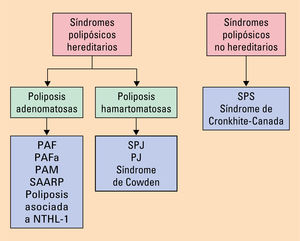
Los síndromes polipósicos colorrectales constituyen un grupo heterogéneo de entidades que comparten la aparición de múltiples pólipos a lo largo del tracto digestivo. Pueden ocurrir como consecuencia de una mutación germinal o de forma esporádica, y es importante reconocerlos para poder establecer un manejo y una vigilancia adecuados en el paciente y en sus familiares de riesgo, ya que asocian un aumento de la incidencia de cáncer colorrectal con respecto a la población general. El diagnóstico de estas patologías se basa en un conjunto de criterios clínicos y genéticos, en caso de identificar una mutación responsable. En este sentido, la reciente aparición de paneles multigén ha permitido agilizar el diagnóstico en la práctica clínica diaria.

Palabras clave
Poliposis adenomatosa
Poliposis hamartomatosa
Poliposis serrada
Cáncer colorrectal
Abstract

Colorectal polyposis syndromes are a heterogeneous group of entities that have the emergence of multiple polyps along the digestive tract in common. They can occur as a consequence of a germline mutation or sporadically. It is important to recognize them in order to establish appropriate management and monitoring in patients and their relatives who are at risk, given that they are associated with an increased incidence of colorectal cancer compared to the general population. The diagnosis of these diseases is based on a set of clinical and genetic criteria, in the event a mutation responsible for it is identified. In this regard, the recent emergence of multigene panels has made it easier to reach a diagnosis in daily clinical practice.

Keywords
Adenomatous polyposis
Hamartomatous polyposis
Serrated polyposis
Colorectal cancer

Identifíquese

¿Aún no es suscriptor de la revista?

Comprar el acceso al artículo

Comprando el artículo el pdf del mismo podrá ser descargado

Teléfono para incidencias

De lunes a viernes de 9h a 18h (GMT+1) excepto los meses de julio y agosto que será de 9 a 15h

Llamadas desde España 932 415 960
Llamadas desde fuera de España +34 932 415 960
Bibliografía
[1]
M.E. Van Leerdam
202403080632510598
202403080632510599
, V.H. Roos, J.E. van Hooft, E. Dekker, R. Jover, M.F. Kaminski, et al.
Endoscopic management of polyposis syndromes: European Society of Gastrointestinal Endoscopy (ESGE) guideline.
Endoscopy., (2019), 51 pp. 877-895
[2]
G. Basso
2024030806325105910
2024030806325105911
, P. Bianchi, A. Malesci, L. Laghi.
Hereditary or sporadic polyposis syndromes.
Best Pract Res Clin Gastroenterol., (2017), 31 pp. 409-417
[3]
R. Patel
2024030806325105912
2024030806325105913
, W. Hyer.
Practical management of polyposis syndromes.
Frontline Gastroenterol., (2019), 10 pp. 379-387
[4]
J. Cubiella
2024030806325105914
2024030806325105915
, M. Marzo-Castillejo, J.J. Mascort-Roca, F.J. Amador-Romero, B. Bellas-Beceiro, J. Clofent-Vilaplana, et al.
Guía de práctica clínica. Diagnóstico y prevención del cáncer colorrectal. actualización 2018.
Gastroenterol Hepatol., (2018), 41 pp. 585-596
[5]
B. Rivera
2024030806325105916
2024030806325105917
, S. González, E. Sánchez-Tomé, I. Blanco, F. Mercadillo, R. Letón, et al.
Clinical and genetic characterization of classical forms of familial adenomatous polyposis: A Spanish population study.
Ann Oncol., (2011), 22 pp. 903-909
[6]
A.K. Win
2024030806325105918
2024030806325105919
, J.C. Reece, J.G. Dowty, D.D. Buchanan, M. Clendenning, C. Rosty, et al.
Risk of extracolonic cancers for people with biallelic and monoallelic mutations in MUTYH.
Int J Cancer., (2016), 139 pp. 1557-1563
[7]
E.G. Sutcliffe
2024030806325105920
2024030806325105921
, A. Bartenbaker Thompson, A.R. Stettner, M.L. Marshall, M.E. Roberts, L.R. Susswein, et al.
Multi-gene panel testing confirms phenotypic variability in MUTYH-associated polyposis.
Fam Cancer., (2019), 18 pp. 203-209
[8]
C. Palles
2024030806325105922
2024030806325105923
, J.B. Cazier, K.M. Howarth, E. Domingo, A.M. Jones, P. Broderick, CORGI Consortium, WGS500 Consortium, A. Lucassen, C.C. Holmes, D. Bentley, P. Donnelly, J. Taylor, C. Petridis, et al.
Germline mutations affecting the proofreading domains of POLE and POLD1 predispose to colorectal adenomas and carcinomas.
Nat Genet., (2013), 45 pp. 136-144
[9]
S. Briggs
2024030806325105924
, I. Tomlinson.
Germline and somatic polymerase ɛ and δ mutations define a new class of hypermutated colorectal and endometrial cancers.
J Pathol., (2013), 230 pp. 148-153
[10]
I. Spier
2024030806325105925
2024030806325105926
, S. Holzapfel, J. Altmüller, B. Zhao, S. Horpaopan, S. Vogt, et al.
Frequency and phenotypic spectrum of germline mutations in POLE and seven other polymerase genes in 266 patients with colorectal adenomas and carcinomas.
Int J Cancer., (2015), 137 pp. 320-331
[11]
C. Esteban-Jurado
2024030806325105927
2024030806325105928
, D. Giménez-Zaragoza, J. Muñoz, S. Franch-Expósito, M. Álvarez-Barona, T. Ocaña, et al.
POLE and POLD1 screening in 155 patients with multiple polyps and early-onset colorectal cancer.
Oncotarget., (2017), 8 pp. 26732-26743
[12]
R.D.A. Weren
2024030806325105929
2024030806325105930
, M.J.L. Ligtenberg, C.M. Kets, R.M. de Voer, E.T. Verwiel, L. Spruijt, et al.
A germline homozygous mutation in the base-excision repair gene NTHL1 causes adenomatous polyposis and colorectal cancer.
Nat Genet., (2015), 47 pp. 668-671
[13]
C.J. Ortiz-Rivera
2024030806325105931
2024030806325105932
.
Artículo de interés ¿Qué hay de nuevo sobre el síndrome de Peutz-Jeghers?.
Revista Gastrohnup., (2017), 2 pp. 1-7
[14]
B. Heald
2024030806325105933
2024030806325105934
, J. Mester, L. Rybicki, M.S. Orloff, C.A. Burke, C. Eng.
Frequent gastrointestinal polyps and colorectal adenocarcinomas in a prospective series of PTEN mutation carriers.
Gastroenterology., (2010), 139 pp. 1927-1933
[15]
R. Pilarski
2024030806325105935
2024030806325105936
, R. Burt, W. Kohlman, L. Pho, K.M. Shannon, E. Swisher.
Cowden syndrome and the PTEN hamartoma tumor syndrome: systematic review and revised diagnostic criteria.
J Natl Cancer Inst., (2013), 105 pp. 1607-1616
[16]
B. Leggett
2024030806325105937
2024030806325105938
, V. Whitehall.
Role of the serrated pathway in colorectal cancer pathogenesis.
Gastroenterology., (2010), 138 pp. 2088-2100
[17]
D.C. Snover
2024030806325105939
2024030806325105940
.
Update on the serrated pathway to colorectal carcinoma.
Hum Pathol., (2011), 42 pp. 1-10
[18]
J.E.G. Jspeert
2024030806325105941
2024030806325105942
, R. Bevan, C. Senore, M.F. Kaminski, E.J. Kuipers, A. Mroz, et al.
Detection rate of serrated polyps and serrated polyposis syndrome in colorectal cancer screening cohorts: a European overview.
Gut., (2017), 66 pp. 1225-1232
[19]
S. Carballal
2024030806325105943
2024030806325105944
, D. Rodríguez-Alcalde, L. Moreira, L. Hernández, L. Rodríguez, F. Rodríguez-Moranta, et al.
Colorectal cancer risk factors in patients with serrated polyposis syndrome: a large multicentre study.
Gut., (2016), 65 pp. 1829-1837
[20]
A.G.C. Bleijenberg
2024030806325105945
2024030806325105946
, J.E.G. IJspeert, Y.J. van Herwaarden, S. Carballal, M. Pellisé, G. Jung, et al.
Personalised surveillance for serrated polyposis syndrome: results from a prospective 5-year international cohort study.
[21]
C. Rosty
2024030806325105947
2024030806325105948
, L.A.A. Brosens, E. Dekker, I.D. Nagtegaal.
Serrated polyposis.
WHO classification of tumours. Digestive system tumours, 5th ed., International Agency for Research on Cancer (IARC), pp. 532-534