

Vol. 12. Núm. 73.
Páginas 4259-4272 (Marzo 2019)

Actualización
Trastornos del movimiento. Etiopatogenia. Clasificación. Síndromes coreicos y distonía

Movement disorders. Etiology. Classification. Chorea syndromes and dystonia

S. Jesús Maestre
Doi : https://10.1016/j.med.2019.03.001
Opciones
Resumen

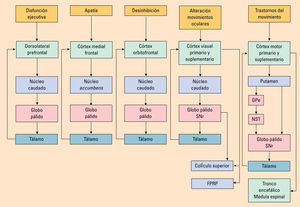
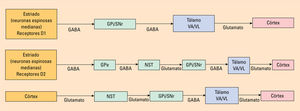
La semiología de los trastornos del movimiento es variada. Se pueden clasificar según el tipo de movimiento y síndrome. Entre los síndromes hipocinéticos destaca el parkinsonismo y entre los hipercinéticos la distonía, las mioclonías, los tic y la corea. La etiología es diversa y, a nivel fisiopatológico, predomina la disfunción de los ganglios de la base con sus conexiones corticales.

La distonía se caracteriza por una contracción anormal de músculos agonistas y antagonistas, dando lugar a posturas anormales. Según la clasificación de las distonías, esas se clasifican siguiendo dos grandes axis, las características clínicas y la etiología. Dentro de la etiología con causa genética, se han identificado más de veinte loci, denominados previamente DYT.

La corea hace referencia a movimientos aleatorios, sin propósito e involuntarios que pueden ser secundarios a múltiples causas, entre ellas las enfermedades genéticamente determinadas. La enfermedad de Huntington es una entidad autosómico dominante por expansión patológica de tripletes en el gen HTT. Se trata de una enfermedad neurodegenerativa, en la que pueden coexistir múltiples trastornos del movimiento como corea, distonía y parkinsonismo.

El tratamiento tanto de la distonía primaria o genéticamente determinada como el de la enfermedad de Huntington y otras causas primarias de corea son sintomáticas.

Palabras clave
Trastornos del movimiento
Circuito de los ganglios de la base
Corea
Distonía
Parkinsonismo
Mioclonías
Enfermedad de Huntington
Abstract

Semiology of movement disorders is varied. They are classified by movement type and syndrome. Parkinsonism is the most prominent hypokinetic syndrome; while among hypokinetic highlight dystonia, myoclonus, tic and chorea. The etiology is diverse, predominating pathophysiologically the dysfunction of basal ganglia and its cortical connections.

Abnormal contraction of agonist and antagonist muscles takes place in dystonia, causing abnormal postures. Dystonias are classified according to the area of the body that is affected, clinical characteristics and etiology. More than twenty loci, previously named DYT loci, haven been identified in genetic dystonia.

Chorea describes involuntary, purposeless and irregular movements. Several causes can lead to choreic movements, for example genetically determined diseases. Huntington's disease is an autosomal-dominant disease caused by a pathological triplet repeat expansion in HTT gene. It is a neurodegenerative disorder co-existing with multiple movement disorders (chorea, dystonia and parkinsonism).

Primary and genetically determined dystonia as well as Huntington's disease and other primary chorea, are treated symptomatically.

Keywords
Movements disorders
Basal ganglia circuit
Chorea
Dystonía
Parkinsonism
Myoclonus
Huntington's disease

Identifíquese

¿Aún no es suscriptor de la revista?

Comprar el acceso al artículo

Comprando el artículo el pdf del mismo podrá ser descargado

Teléfono para incidencias

De lunes a viernes de 9h a 18h (GMT+1) excepto los meses de julio y agosto que será de 9 a 15h

Llamadas desde España 932 415 960
Llamadas desde fuera de España +34 932 415 960
Bibliografía
[1]
201903160607182728
R.B. Postuma, A. Dagher.
Basal ganglia functional connectivity based on a meta-analysis of 126 positron emission tomography and functional magnetic resonance imaging publications.
Cereb Cortex., (2006), 16 pp. 1508-1521
[2]
201903160607182729
G.E. Alexander.
Basal ganglia-thalamocortical circuits: their role in control of movements.
J Clin Neurophysiol., (1994), 11 pp. 420-431
[3]
2019031606071827210
G.E. Alexander, M.D. Crutcher.
Functional architecture of basal ganglia circuits: neural substrates of parallel processing.
Trends Neurosci., (1990), 13 pp. 266-271
[4]
2019031606071827211
G.E. Alexander, M.D. Crutcher, M.R. DeLong.
Basal ganglia-thalamocortical circuits: parallel substrates for motor, oculomotor, “prefrontal” and “limbic” functions.
Prog Brain Res., (1990), 85 pp. 119-146
[5]
2019031606071827212
M.E. Anderson, F.B. Horak.
Influence of the globus pallidus on arm movements in monkeys. III. Timing of movement-related information.
J Neurophysiol., (1985), 54 pp. 433-448
[6]
2019031606071827213
M. Kimura.
Behaviorally contingent property of movement-related activity of the primate putamen.
J Neurophysiol., (1990), 63 pp. 1277-1296
[7]
2019031606071827214
C.D. Marsden, J.A. Obeso.
The functions of the basal ganglia and the paradox of stereotaxic surgery in Parkinson's disease.
Brain, (1994), 117 pp. 877-897
[8]
2019031606071827215
J.R. Wickens, J.N. Reynolds, B.I. Hyland.
Neural mechanisms of reward-related motor learning.
Curr Opin Neurobiol., (2003), 13 pp. 685-690
[9]
2019031606071827216
2019031606071827217
A. Albanese, K. Bhatia, S.B. Bressman, M.R. Delong, S. Fahn, V.S. Fung, et al.
Phenomenology and classification of dystonia: a consensus update.
Mov Disord., (2003), 28 pp. 863-873
[10]
2019031606071827218
T.D. Steeves, L. Day, J. Dykeman, N. Jette, T. Pringsheim.
The prevalence of primary dystonia: a systematic review and meta-analysis.
Mov Disord., (2012), 27 pp. 1789-1796
[11]
2019031606071827219
L. Wang, Y. Chen, B. Hu, X. Hu.
Late-onset primary dystonia in Zhejiang province of China: a service-based epidemiological study.
Neurol Sci., (2016), 37 pp. 111-116
[12]
2019031606071827220
L. Williams, E. McGovern, O. Kimmich, A. Molloy, I. Beiser, J.S. Butler, et al.
Epidemiological, clinical and genetic aspects of adult onset isolated focal dystonia in Ireland.
Eur J Neurol., (2017), 24 pp. 73-81
[13]
2019031606071827221
B. Balint, A. Vincent, H.M. Meinck, S.R. Irani, K.P. Bhatia.
Movement disorders with neuronal antibodies: syndromic approach, genetic parallels and pathophysiology.
Brain, (2018), 141 pp. 13-36
[14]
2019031606071827222
H. Ichinose, T. Ohye, E. Takahashi, N. Seki, T. Hori, M. Segawa, et al.
Hereditary progressive dystonia with marked diurnal fluctuation caused by mutations in the GTP cyclohydrolase I gene.
Nat Genet., (1994), 8 pp. 236-242
[15]
2019031606071827223
2019031606071827224
K. Lohmann, C. Klein.
Update on the genetics of dystonia.
Curr Neurol Neurosci Rep., (2017), 17 pp. 26
[16]
2019031606071827225
C. Marras, K. Lohmann, A. Lang, C. Klein.
Fixing the broken system of genetic locus symbols: Parkinson disease and dystonia as examples.
Neurology, (2012), 78 pp. 1016-1024
[17]
2019031606071827226
2019031606071827227
C. Marras, A. Lang, B.P. van de Warrenburg, C.M. Sue, S.J. Tabrizi, L. Bertram, et al.
Nomenclature of genetic movement disorders: Recommendations of the international Parkinson and movement disorder society task force.
Mov Disord., (2016), 31 pp. 436-457
[18]
2019031606071827228
L.J. Ozelius, J.W. Hewett, C.E. Page, S.B. Bressman, P.L. Kramer, C. Shalish, et al.
The early-onset torsion dystonia gene (DYT1) encodes an ATP-binding protein.
Nat Genet., (1997), 17 pp. 40-48
[19]
2019031606071827229
J.C. Leung, C. Klein, J. Friedman, P. Vieregge, H. Jacobs, D. Doheny, et al.
Novel mutation in the TOR1A (DYT1) gene in atypical early onset dystonia and polymorphisms in dystonia and early onset parkinsonism.
Neurogenetics, (2001), 3 pp. 133-143
[20]
2019031606071827230
B. Zirn, K. Grundmann, P. Huppke, J. Puthenparampil, H. Wolburg, O. Riess, et al.
Novel TOR1A mutation p.Arg288Gln in early-onset dystonia (DYT1).
J Neurol Neurosurg Psychiatry, (2008), 79 pp. 1327-1330
[21]
2019031606071827231
N. Calakos, V.D. Patel, M. Gottron, G. Wang, K.N. Tran-Viet, D. Brewington, et al.
Functional evidence implicating a novel TOR1A mutation in idiopathic, late-onset focal dystonia.
J Med Genet., (2010), 47 pp. 646-650
[22]
2019031606071827232
2019031606071827233
S.B. Bressman, C. Sabatti, D. Raymond, D. de Leon, C. Klein, P.L. Kramer, et al.
The DYT1 phenotype and guidelines for diagnostic testing.
Neurology, (2000), 54 pp. 1746-1752
[23]
2019031606071827234
S.B. Bressman, D. Raymond, T. Fuchs, G.A. Heiman, L.J. Ozelius, R. Saunders-Pullman.
Mutations in THAP1 (DYT6) in early-onset dystonia: a genetic screening study.
Lancet Neurol., (2009), 8 pp. 441-446
[24]
2019031606071827235
M.S. LeDoux, J. Xiao, M. Rudzińska, R.W. Bastian, Z.K. Wszolek, J.A. Van Gerpen, et al.
Genotype-phenotype correlations in THAP1 dystonia: molecular foundations and description of new cases.
Parkinsonism Relat Disord., (2012), 18 pp. 414-425
[25]
2019031606071827236
F.B. Cheng, J.C. Feng, L.Y. Ma, J. Miao, T. Ott, X.H. Wan, et al.
Combined occurrence of a novel TOR1A and a THAP1 mutation in primary dystonia.
Mov Disord., (2014), 29 pp. 1079-1083
[26]
2019031606071827237
M.S. LeDoux, S.R. Vemula, J. Xiao, M.M. Thompson, J.S. Perlmutter, L.J. Wright, et al.
Clinical and genetic features of cervical dystonia in a large multicenter cohort.
Neurology. Neurol Genet., (2016), 2 pp. e69
[27]
2019031606071827238
K.R. Kumar, K. Lohmann, I. Masuho, R. Miyamoto, A. Ferbert, T. Lohnau, et al.
Mutations in GNAL: a novel cause of craniocervical dystonia.
JAMA Neurol., (2014), 71 pp. 490-494
[28]
2019031606071827239
I. Masuho, M. Fang, C. Geng, J. Zhang, H. Jiang, R.K. Özgul, et al.
Homozygous GNAL mutation associated with familial childhood-onset generalized dystonia.
Neurol Genet., (2016), 2 pp. e78
[29]
2019031606071827240
K. Lohmann, R.A. Wilcox, S. Winkler, A. Ramírez, A. Rakovic, J.S. Park, et al.
Whispering dysphonia (DYT4 dystonia) is caused by a mutation in the TUBB4 gene.
Ann Neurol., (2013), 73 pp. 537-545
[30]
2019031606071827241
R. Erro, J. Hersheson, C. Ganos, N.E. Mencacci, M. Stamelou, A. Batla, et al.
H-ABC syndrome and DYT4: Variable expressivity or pleiotropy of TUBB4 mutations?.
Mov Disord., (2015), 30 pp. 828-833
[31]
2019031606071827242
G. Charlesworth, V. Plagnol, K.M. Holmström, J. Bras, U.M. Sheerin, E. Preza, et al.
Mutations in ANO3 cause dominant craniocervical dystonia: ion channel implicated in pathogenesis.
Am J Hum Genet., (2012), 91 pp. 1041-1050
[32]
2019031606071827243
L.Y. Ma, L. Wang, Y.M. Yang, T. Feng, X.H. Wan.
Mutations in ANO3 and GNAL gene in thirty-three isolated dystonia families.
Mov Disord., (2015), 30 pp. 743-744
[33]
2019031606071827244
J. Xiao, R.J. Uitti, Y. Zhao, S.R. Vemula, J.S. Perlmutter, Z.K. Wszolek, et al.
Mutations in CIZ1 cause adult onset primary cervical dystonia.
Ann Neurol., (2012), 71 pp. 458-469
[34]
2019031606071827245
G. Charlesworth, P.R. Angelova, F. Bartolomé-Robledo, M. Ryten, D. Trabzuni, M. Stamelou, et al.
Mutations in HPCA cause autosomal-recessive primary isolated dystonia.
Am J H G, (2015), 96 pp. 657-665
[35]
2019031606071827246
M. Zech, D.D. Lam, L. Francescatto, B. Schormair, A.V. Salmine, A. Jochim, et al.
Recessive mutations in the alpha3 (VI) collagen gene COL6A3 cause early-onset isolated dystonia.
Am J Hum Genet., (2015), 96 pp. 657-665
[36]
2019031606071827247
K. Lohmann, F. Schlicht, M. Svetel, F. Hinrichs, S. Zittel, J. Graf, et al.
The role of mutations in COL6A3 in isolated dystonia.
J Neurol., (2016), 263 pp. 730-734
[37]
2019031606071827248
S. Wijemanne, J. Jankovic.
Dopa-responsive dystonia–clinical and genetic heterogeneity.
Nature reviews. Neurology, (2015), 11 pp. 414-424
[38]
2019031606071827249
T. Opladen, G. Hoffmann, F. Hörster, A.B. Hinz, K. Neidhardt, C. Klein, et al.
Clinical and biochemical characterization of patients with early infantile onset of autosomal recessive GTP cyclohydrolase I deficiency without hyperphenylalaninemia.
Mov Disord., (2011), 26 pp. 157-161
[39]
2019031606071827250
K. Hisatake, S. Hasegawa, R. Takada, Y. Nakatani, M. Horikoshi, R.G. Roeder.
The p250 subunit of native TATA box-binding factor TFIID is the cell-cycle regulatory protein CCG1.
Nature, (1993), 362 pp. 179-181
[40]
2019031606071827251
S. Makino, R. Kaji, S. Ando, M. Tomizawa, K. Yasuno, S. Goto, et al.
Reduced neuron-specific expression of the TAF1 gene is associated with X-linked dystonia-parkinsonism.
Am J Hum Genet., (2007), 80 pp. 393-406
[41]
2019031606071827252
P. de Carvalho Aguiar, K.J. Sweadner, J.T. Penniston, J. Zaremba, L. Liu, M. Caton, et al.
Mutations in the Na+/K+ -ATPase alpha3 gene ATP1A3 are associated with rapid-onset dystonia parkinsonism.
[42]
2019031606071827253
2019031606071827254
M.T. Sweney, T.M. Newcomb, K.J. Swoboda.
The expanding spectrum of neurological phenotypes in children with ATP1A3 mutations, alternating hemiplegia of childhood, rapid-onset dystonia-parkinsonism, CAPOS and beyond.
Pediatric Neurol., (2015), 52 pp. 56-64
[43]
2019031606071827255
M. Hully, J. Ropars, L. Hubert, N. Boddaert, M. Rio, M. Bernardelli, et al.
Mosaicism in ATP1A3-related disorders: not just a theoretical risk.
Neurogenetics, (2017), 18 pp. 23-28
[44]
2019031606071827256
S. Camargos, S. Scholz, J. Simón-Sánchez, C. Paisán-Ruiz, P. Lewis, D. Hernandez, et al.
DYT16, a novel young-onset dystonia-parkinsonism disorder: identification of a segregating mutation in the stress-response protein PRKRA.
Lancet Neurol., (2008), 7 pp. 207-215
[45]
2019031606071827257
M. Quadri, S. Olgiati, M. Sensi, F. Gualandi, E. Groppo, V. Rispoli, et al.
PRKRA mutation causing early-onset generalized dystonia-parkinsonism (dyt16) in an Italian family.
Mov Disord., (2016), 31 pp. 765-767
[46]
2019031606071827258
F. Panov, Y. Gologorsky, G. Connors, M. Tagliati, J. Miravite, R.L. Alterman, et al.
Deep brain stimulation in DYT1 dystonia: a 10-year experience.
[47]
2019031606071827259
2019031606071827260
S. Pirio Richardson, A.R. Wegele, B. Skipper, A. Deligtisch, H.A. Jinnah, Dystonia Coalition Investigators.
Dystonia treatment: patterns of medication use in an international cohort.
Neurology, (2017), 88 pp. 543-550
[48]
2019031606071827261
U. Walter, D. Dressler.
Ultrasound-guided botulinum toxin injections in neurology: technique, indications and future perspectives.
Expert Rev Neurother., (2014), 14 pp. 923-936
[49]
2019031606071827262
R.E. Burke, S. Fahn, C.D. Marsden.
Torsion dystonia: a double-blind, prospective trial of high-dosage trihexyphenidyl.
Neurology, (1986), 36 pp. 160-164
[50]
2019031606071827263
R. Robinson, G.T. McCarthy, O. Bandmann, M. Dobbie, R. Surtees, N.W. Wood, et al.
GTP cyclohydrolase deficiency; intrafamilial variation in clinical phenotype, including levodopa responsiveness.
J Neurol Neurosurg Psychiatry, (1999), 66 pp. 86-89
[51]
2019031606071827264
J. Jankovic.
Dopamine depleters in the treatment of hyperkinetic movement disorders.
Expert Opin Pharmacother., (2016), 17 pp. 2461-2470
[52]
2019031606071827265
E. Monbaliu, K. Himmelmann, J.P. Lin, E. Ortibus, L. Bonouvrié, H. Feys, et al.
Clinical presentation and management of dyskinetic cerebral palsy.
Lancet Neurol., (2017), 16 pp. 741-749
[53]
2019031606071827266
E. Hainque, M. Vidailhet, N. Cozic, F. Charbonnier-Beaupel, S. Thobois, C. Tranchant, et al.
A randomized, controlled, double-blind, crossover trial of zonisamide in myoclonus-dystonia.
Neurology, (2016), 86 pp. 1729-1735
[54]
2019031606071827267
2019031606071827268
S. Horisawa, T. Taira, S. Goto, T. Ochiai, T. Nakajima.
Long-term improvement of musician's dystonia after stereotactic ventro-oral thalamotomy.
Ann Neurol., (2013), 74 pp. 648-654
[55]
2019031606071827269
M. Vidailhet, L. Vercueil, J.L. Houeto, P. Krystkowiak, C. Lagrange, J. Yelnik, et al.
Bilateral, pallidal, deep-brain stimulation in primary generalised dystonia: a prospective 3 year follow-up study.
Lancet Neurol., (2007), 6 pp. 223-229
[56]
2019031606071827270
J. Volkmann, A. Wolters, A. Kupsch, J. Müller, A.A. Kühn, G.H. Schneider, et al.
Pallidal deep brain stimulation in patients with primary generalised or segmental dystonia: 5-year follow-up of a randomised trial.
Lancet Neurol., (2012), 11 pp. 1029-1038
[57]
2019031606071827271
P. Krause, N. Brüggemann, S. Völzmann, A. Horn, A. Kupsch, G.H. Schneider, et al.
Long-term effect on dystonia after pallidal deep brain stimulation (DBS) in three members of a family with a THAP1 mutation.
J Neurol., (2015), 262 pp. 2739-2744
[58]
2019031606071827272
F. Cardoso, K. Seppi, K.J. Mair, G.K. Wenning, W. Poewe.
Seminar on choreas.
Lancet Neurol., (2006), 5 pp. 589-602
[59]
2019031606071827273
L. Sabater, C. Gaig, E. Gelpi, L. Bataller, J. Lewerenz, E. Torres-Vega, et al.
A novel non-rapid-eye movement and rapid-eye-movement parasomnia with sleep breathing disorder associated with antibodies to IgLON5: a case series, characterisation of the antigen, and post-mortem study.
Lancet Neurol., (2014), 13 pp. 575-586
[60]
2019031606071827274
M. Ryan, J.H. Antony, P.J. Grattan-Smith.
Sydenham's chorea: a resurgence in the 1990s?.
J Paediatr Child Health, (2000), 36 pp. 95-96
[61]
2019031606071827275
2019031606071827276
G. Sanna, M.L. Bertolaccini, M.J. Cuadrado, H. Laing, M.A. Khamashta, A. Mathieu, et al.
Neuropsychiatric manifestations in systemic lupus erythematosus: prevalence and association with antiphospholipid antibodies.
J Rheumatol., (2003), 30 pp. 985-992
[62]
2019031606071827277
D.C. Rubinsztein, J. Leggo, R. Coles, E. Almqvist, V. Biancalana, J.J. Cassiman, et al.
Phenotypic characterization of individuals with 30-40 CAG repeats in the Huntington disease (HD) gene reveals HD cases with 36 repeats and apparently normal elderly individuals with 36-39 repeats.
Am J Hum Genet., (1996), 59 pp. 16-22
[63]
2019031606071827278
2019031606071827279
D. Letort, P. González-Alegre.
Huntington's disease in children.
Handb Clin Neurol., (2013), 113 pp. 1913-1917
[64]
2019031606071827280
E.J. Wild, S.J. Tabrizi.
Therapies targeting DNA and RNA in Huntington's disease.
Lancet Neurol., (2017), 16 pp. 837-847
[65]
2019031606071827281
T.A. Mestre.
Chorea.
Continuum (Minneap Minn), (2016), 22 pp. 1186-1207
[66]
2019031606071827282
M.E. Dy, F.C. Chang, S.D. Jesus, I. Anselm, N. Mahant, P. Zeilman, et al.
Treatment of ADCY5-associated dystonia, chorea, and hyperkinetic disorders with deep brain stimulation: a multicenter case series.
J Child Neurol., (2016), 31 pp. 1027-1035
[67]
2019031606071827283
B. Biolsi, L. Cif, H.E. Fertit, S.G. Robles, P. Coubes.
Long-term follow-up of Huntington disease treated by bilateral deep brain stimulation of the internal globus pallidus.
J Neurosurg., (2008), 109 pp. 130-132
[68]
2019031606071827284
V. González, L. Cif, B. Biolsi, S. García-Ptacek, A. Seychelles, E. Sanrey, et al.
Deep brain stimulation for Huntington's disease: long-term results of a prospective open-label study.
J Neurosurg., (2014), 121 pp. 114-122