
Vol. 11. Núm. 22.
Páginas 1337-1344 (Noviembre 2012)

Alteraciones de la hemostasia primaria. Púrpuras y alteraciones de las plaquetas

Disorders of primary hemostasis. Purpurae and plaquetary alterations

J.A. Páramo FernándezA. Alfonso PiérolaS. Varea Díaz
Doi : https://10.1016/S0304-5412(12)70460-2
Opciones
Resumen

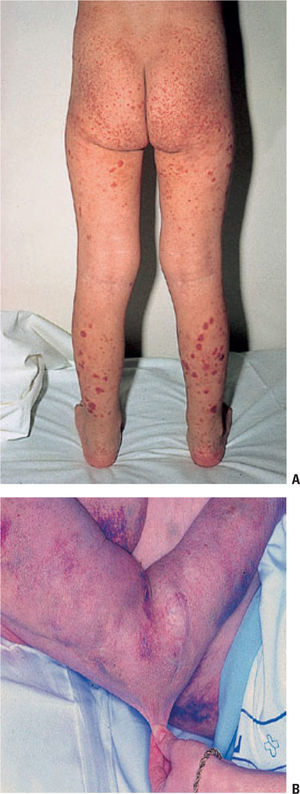
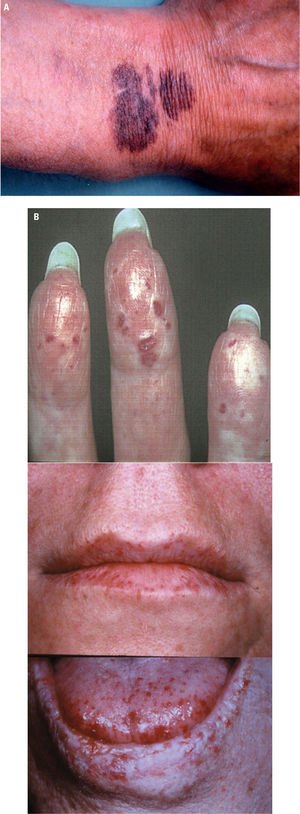
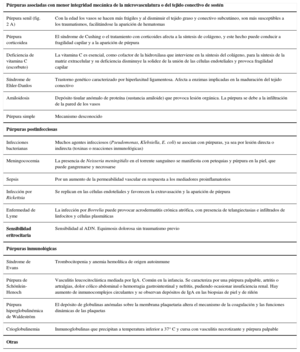
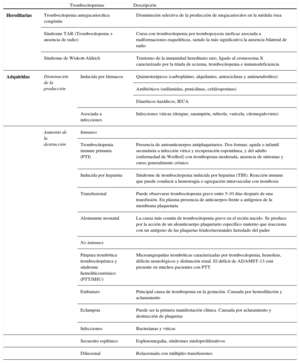
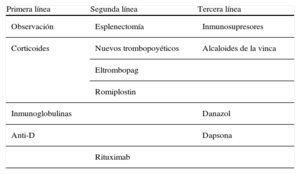
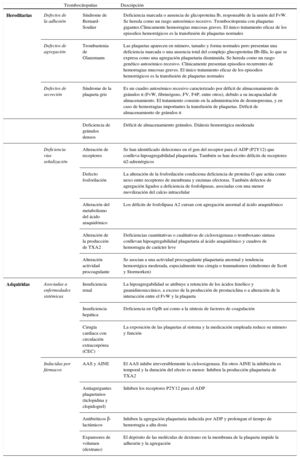
Las púrpuras representan la patología genuina de los trastornos de la hemostasia primaria y se dividen en: a) púrpuras vasculares, con alteración en el componente vascular, con número y función plaquetaria normal y hemorragias cutáneas superficiales; b) púrpuras trombopénicas, causadas por un fallo cuantitativo en el componente plaquetario, de ellas, el cuadro más importante es la trombocitopenia inmune primaria (PTI) causada por autoanticuerpos antiplaquetarios, con una forma infantil autolimitada y otra crónica presente en adultos y cuadro hemorrágico cutaneomucoso; el tratamiento de primera línea de la PTI son los corticoides e inmunoglobulinas, y de segunda línea la esplenectomía y los nuevos agentes trombopoyéticos como romiplostin y eltrombopag y c) púrpuras trombopáticas, causadas por un fallo cualitativo, que pueden ser congénitas, como síndrome de Bernard-Soulier y trombastenia de Glanzmann, o adquiridas (por ejemplo, hepatopatía, enfermedad renal, ingesta de antiplaquetarios, etc.). El tratamiento se basa en la administración de antifibrinolíticos y desmopresina en las formas moderadas y concentrado de plaquetas y factor VII activado recombinante en las formas graves.

Palabras clave
Plaquetas
Púrpura
Hemorragia cutaneomucosa
Trombopenia
Trombopatía
Romiplostin
Eltrombopag
Abstract

Purpurae are the epitome of disorders in primary hemostasis and can be categorized in: a) vascular purpurae, in which the vascular component is altered with normal platelet numbers and function, leading to superficial skin hemorrhages; b) thrombopenic purpurae, because of a quantitative loss in the platelet component, perhaps the most important among them is Primary Immune Thrombocytopenia (PIT), which is caused by anti-platelet antibodies and has both a self-limited childhood form and a chronic one that occurs in adults, the clinical picture consists of mucocutaneous hemorrhages, the first line treatments for PIT are corticosteroids and immunoglobulins, the second line treatments are splenectomy and the novel thrombopoietic treatments such as romiplostin and eltrompobag and c) thrombopatic purpurae, because of a qualitative deficit, which can be congenital such as the Bernard-Soulier syndrome or Glanzmann's Thrombasthenia, or acquired (i.e. liver disease, renal disease, ingestion of antiplatelet agents, etc.). The treatment consists of antifibrinolytics and desmopressin in the moderate cases or platelet concentrate and recombinant activated factor VII in the severe ones.

Keywords
Platelets
Purpura
Mucocutaneous hemorrhage
Thrombopenia
Thrombopathy
Romiplostin
Eltrombopag

Identifíquese

¿Aún no es suscriptor de la revista?

Comprar el acceso al artículo

Comprando el artículo el pdf del mismo podrá ser descargado

Teléfono para incidencias

De lunes a viernes de 9h a 18h (GMT+1) excepto los meses de julio y agosto que será de 9 a 15h

Llamadas desde España 932 415 960
Llamadas desde fuera de España +34 932 415 960
Bibliografía
[1.]
J. McDonald, P. Bayrak-Toydemir, R.E. Pyeritz.
Hereditary hemorrhagic telangiectasia: an overview of diagnosis, management, and pathogenesis.
Genet Med, (2011), 11 pp. 607-616
[2.]
Y. Kawasaki.
The pathogenesis and treatment of pediatric Henoch-Schönlein purpura nephritis.
Clin Exp Nephrol, (2011), 15 pp. 648-657
[3.]
A.E. Geddis.
Inherited thrombocytopenia: congenital megakaryocitic thrombocytopenia and thrombocytopenia with absent radii.
Semin Hematol, (2006), 43 pp. 178-188
[4.]
J.A. Páramo Fernández.
Trastornos vasculares hemorrágicos. Principios de Fisiopatología para la Atención Farmacéutica, Módulo I.
Consejo General de Colegios Oficiales de Farmacéuticos de España, (2007), pp. 127-148
[5.]
N. Pujol-Moix, E. Muñiz, C. Besses.
Trombocitopenias y trombocitopatías.
Hematología clínica, Elsevier, pp. 683-724
[6.]
N. Cooper, I. Bussel.
The pathogenesis of immune thrombocytopenic purpura.
Br J Haematol, (2006), 133 pp. 364-374
[7.]
D. Provan, R. Stasi, A.C. Newland, V.S. Blanchette, P. Bolton-Maggs, J.B. Bussel, et al.
International consensus report on the investigation and management of primary immune thrombocytopenia.
[8.]
A.T. Nurden, J.F. Viallard, P. Nurden.
New-generation drugs that stimulate platelet production in chronic immune thrombocytopenic purpura.
Lancet, (2009), 373 pp. 1562-1569
[9.]
D.J. Kuter, M. Rummel, R. Boccia, B.G. Macik, I. Pabinger, D. Selleslag, et al.
Romiplostim or standard of care in patients with immune thrombocytopenia.
N Engl J Med, (2010), 363 pp. 1889-1899
[10.]
G. Cheng, M.N. Saleh, C. Marcher, S. Vasey, B. Mayer, M. Aivado, et al.
Eltrombopag for management of chronic immune thrombocytopenia (RAISE): a 6-month, randomised, phase 3 study.
[11.]
P. Nurden, A.T. Nurden.
Congenital disorders associated with platelet dysfunctions.
Thromb Haemost, (2008), 99 pp. 253-263
[12.]
I. Ramasamy.
Inherited bleeding disorders: disorders of platelet adhesion and aggregation.
Crit Rev Oncol Hematol, (2004), 49 pp. 1-35
[13.]
S. Bellucci, J. Caen.
Molecular basis of Glanzmann's Thrombasthenia and current strategies in treatment.
Blood Rev, (2002), 16 pp. 193-202
[14.]
N.O. Solum.
Procoagulant expression in platelets and defects leading to clinical disorders.
Arterioscler Thromb Vasc Biol, (1999), 19 pp. 2841-2846
[15.]
L.D. Notarangelo, L. Mori.
Wiskott-Aldrich syndrome: another piece in the puzzle.
Clin Exp Immunol, (2005), 139 pp. 173-175
[16.]
C.L. Balduini, A. Pecci, A. Savoia.
Recent advances in the understanding and management of MYH9-related inherited thrombocytopenias.
Br J Haematol, (2011), 154 pp. 161-174
[17.]
A. Tripodi, P.M. Mannucci.
The coagulopathy of chronic liver disease.
N Engl J Med, (2011), 365 pp. 147-156
[18.]
H.E. Achneck, B. Sileshi, A. Parikh, C.A. Milano, I.J. Welsby, J.H. Lawson.
Pathophysiology of bleeding and clotting in the cardiac surgery patient: from vascular endothelium to circulatory assist device surface.
Circulation, (2010), 122 pp. 2068-2077
[19.]
F. Rodeghiero, A. Tosetto, T. Abshire, D.M. Arnold, B. Coller, P. James, et al.
ISTH/SSC joint VWF and Perinatal/Pediatric Hemostasis Subcommittees Working Group. ISTH/SSC bleeding assessment tool: a standardized questionnaire and a proposal for a new bleeding score for inherited bleeding disorders.
J Thromb Haemost, (2010), 8 pp. 2063-2065
[20.]
J.G. Drachman.
Inherited thrombocytopenia: when a low platelet count does not mean ITP.
Blood, (2004), 103 pp. 390-398
[21.]
G.C. White.
Congenital and acquired platelet disorders: current dilemmas and treatment strategies.
Semin Hematol, (2006), 43 pp. 537-541
Copyright © 2012. Elsevier España, S.L.. Todos los derechos reservados