
Vol. 11. Núm. 22.
Páginas 1327-1336 (Noviembre 2012)

Sistema hemostático: fisiopatología y aproximación clínica y diagnóstica

The hemostatic system: physiopatology with a clinical and diagnostical approach

J.A. Páramo Fernández
Doi : https://10.1016/S0304-5412(12)70459-6
Opciones
Resumen

La hemostasia representa un mecanismo de defensa del organismo para prevenir la pérdida excesiva de sangre cuando se produce una lesión vascular. Según la hipótesis celular actual, la coagulación sería una sinfonía en la que múltiples sistemas interaccionan simultáneamente en concierto con superficies celulares de las plaquetas y el endotelio vascular para generar un coágulo estable de fibrina. Una alteración del balance hemostático puede favorecer la hemorragia o la trombosis.

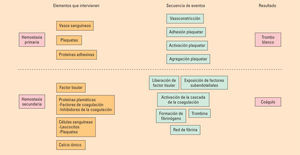
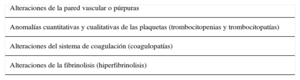
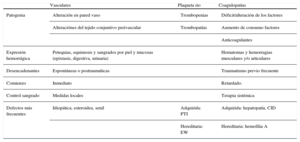
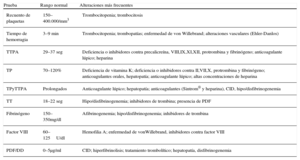
La historia clínica será de vital importancia para establecer la naturaleza congénita o adquirida del trastorno hemostático. La interpretación de las pruebas de coagulación y fibrinolisis requiere el conocimiento de las principales vías implicadas, existiendo en la actualidad dispositivos que permiten su determinación a la cabecera del paciente. Las alteraciones hemostáticas pueden afectar a la hemostasia primaria o plaquetaria y cursar con hemorragias cutaneomucosas, o a la coagulación sanguínea (hemostasia secundaria), con hemorragias a nivel muscular, articular o en cavidades.

Palabras clave
Hemostasia primaria
Coagulación
Fibrinolisis
Factor tisular
Hemorragia
Abstract

Hemostasis is a defense mechanism of our organism whose goal is to prevent an excessive loss of blood should a vascular lesion take place. According to the current cellular hypothesis, coagulation would be alike to a symphony in which many systems interact simultaneously along with the cell surfaces of platelets and the vascular endothelium in order to create a stable fibrin clot. Any change in the hemostatic balance may yield to hemorrhages or thrombosis.

The medical history will be pivotal in figuring out if the disease is congenital or acquired. Interpretation of the coagulation and fibrinolysis tests calls for a correct knowledge of the main coagulation pathways. Nowadays there are point of care tests that enable us to test them at the bedside. Changes in hemostasis can alter primary (platelet) hemostasis and lead to mucocutaneous hemorrhages or they can alter secondary (coagulation) hemostasis and cause hemorrhages in muscles, joints or viscera.

Keywords
Primary hemostasis
Coagulation
Fibrinolysis
Tissular factor
Hemorrhage

Identifíquese

¿Aún no es suscriptor de la revista?

Comprar el acceso al artículo

Comprando el artículo el pdf del mismo podrá ser descargado

Teléfono para incidencias

De lunes a viernes de 9h a 18h (GMT+1) excepto los meses de julio y agosto que será de 9 a 15h

Llamadas desde España 932 415 960
Llamadas desde fuera de España +34 932 415 960
Bibliografía
[1.]
J.A. Páramo Fernández.
Trastornos vasculares hemorrágicos.
Principios de fisiopatología para la atención farmacéutica, Módulo I, Consejo General de Colegios Oficiales de Farmacéuticos de España, (2007),
[2.]
M. Shenone, B.C. Furie, B. Furie.
The blood coagulation cascade.
Curr Opin Hematol, (2004), 11 pp. 272-273
[3.]
B.T. Colvin.
Physiology of haemostasis.
[4.]
S.D. O’Connor, A.J. Taylor, E.C. Williams, T.C. Winter.
Coagulation concepts update.
Am J Roentgenol, (2009), 193 pp. 1656-1664
[5.]
R.K. Andrews, M.C. Bernt.
Platelet physiology and thrombosis.
Thromb Res, (2004), 114 pp. 447-453
[6.]
Z.S. Kaplan, S.P. Jackson.
The role of platelets in atherothrombosis.
Hematology Am Soc Hematol Educ Program, (2011), 2011 pp. 51-61
[7.]
G. Davi, C. Patrono.
Platelet activation and atherothrombosis.
N Engl J Med, (2007), 357 pp. 2482-2494
[8.]
T. Flaumenhaft.
Molecular basis of platelet granule secretion.
Arterioscler Thromb Vasc Biol, (2003), 23 pp. 1152-1160
[9.]
F. Müller, T. Renné.
Platelet polyphosphates: the nexus of primary and secondary hemostasis.
Scand J Clin Lab Invest, (2011), 71 pp. 82-86
[10.]
A.P. Owens 3rd, N. Mackman.
Tissue factor and thrombosis: The clot starts here.
Thromb Haemost, (2010), 104 pp. 432-439
[11.]
D.A. Manly, J. Boles, N. Mackman.
Role of tissue factor in venous thrombosis.
Annu Rev Physiol, (2011), 73 pp. 515-525
[12.]
M. Hoffman, D.M. Monroe.
A cell-based model of hemostasis.
Thromb Haemost, (2001), 85 pp. 958-965
[13.]
A.P. Owens 3rd, N. Mackman.
Microparticles in hemostasis and thrombosis.
Circ Res, (2011), 108 pp. 1284-1297
[14.]
J.I. Borissoff, H.M. Spronk, H. ten Cate.
The hemostatic system as a modulator of atherosclerosis.
N Engl J Med, (2011), 364 pp. 1746-1760
[15.]
A. Undas, R.A. Ariëns.
Fibrin clot structure and function: a role in the pathophysiology of arterial and venous thromboembolic diseases.
Arterioscler Thromb Vasc Biol, (2011), 31 pp. e88-e99
[16.]
S. Navarro, E. Bonet, A. Estellés, R. Montes, J. Hermida, L. Martos, et al.
Medina The endothelial cell protein C receptor: its role in thrombosis.
Thromb Res, (2011), 128 pp. 410-416
[17.]
E. Zorio, J. Gilabert-Estellés, F. España, L.A. Ramón, R. Cosín, A. Estellés.
Fibrinolysis: the key to new pathogenetic mechanisms.
Curr Med Chem, (2008), 15 pp. 923-929
[18.]
J.A. Páramo, J.M. Moraleda.
Diagnóstico de los trastornos de la hemostasia.
Pregrado de hematología, Luzán, pp. 537-547
[19.]
S.M. Bates, J.I. Weitz.
Coagulation assays.
Circulation, (2005), 112 pp. e53-e60
[20.]
J. Orbe, R. Montes, J.A. Páramo.
Papel del PAI-1 en los procesos trombóticos.
Med Clin (Barc), (1999), 113 pp. 63-69
Copyright © 2012. Elsevier España, S.L.. Todos los derechos reservados