
Vol. 11. Núm. 22.
Páginas 1345-1352 (Noviembre 2012)

Trombofilia y trombosis

Thrombophilia and thrombosis

J.A. Páramo FernándezR. Lecumberri Villamediana
Doi : https://10.1016/S0304-5412(12)70461-4
Opciones
Resumen

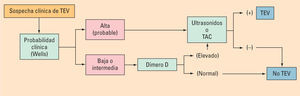
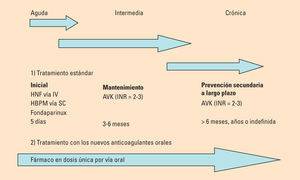
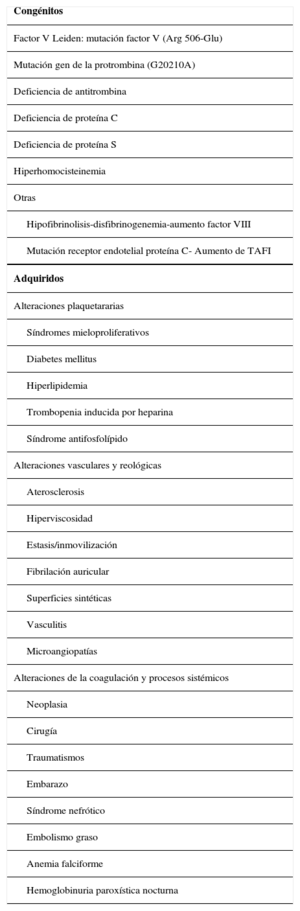
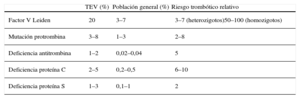
El tromboembolismo venoso (TEV) es una de las causas más importantes de morbilidad y mortalidad en nuestro medio. En su patogenia intervienen las alteraciones de la pared vascular, anomalías del flujo (estasis) y un estado de hipercoagulabilidad (o trombofilia) de la sangre. Los estados trombofílicos pueden ser congénitos, por pérdida de función, como en la deficiencia de anticoagulantes naturales (antitrombina y proteínas C y S), o ganancia de función, como el factor V Leiden o la mutación de la protrombina. El diagnóstico del TEV se realiza mediante la probabilidad clínica, pruebas de imagen no invasivas, como eco-doppler y angio-tomografía computadorizada (TC), y determinación del dímero D. El tratamiento consiste en la administración de heparina de bajo peso molecular por vía subcutánea, seguida de antivitaminas K (acenocumarol o warfarina) por vía oral durante 3–6 meses o indefinidamente si existen factores de riesgo permanentes. En los últimos años se han desarrollado nuevos anticoagulantes orales, inhibidores directos de la trombina o del factor Xa (dabigatran, rivaroxaban, apixaban), que pueden reemplazar a corto plazo a las antivitaminas K.

Palabras clave
Trombosis
Estados trombofílicos
Trombosis venosa profunda
Tromboembolismo pulmonar
Anticoagulantes orales
Abstract

Venous thromboembolism (VTE) accounts for an important share of morbidity and mortality in our societies. Circumstances related to its pathogenesis are vessel wall changes, flow abnormalities (stasis), and hypercoagulability states (thrombophilia). Thrombophilic states may be congenital, because of loss of function such as in natural anticoagulants (antithrombin, protein C, protein S), or gain of function such as Factor V Leiden or prothrombin mutations. VTE diagnosis is achieved by clinical probability, non-invasive imaging techniques such as Doppler or angio-TC and D-dimer measurement. It is treated by the administration of low molecular weight heparin subcutaneously, followed by antivitamin K (acenocumarol, warfarin) orally for 3–6 months or indefinitely if permanent risk factors exist. New oral anticoagulants have been developed within the last few years, which are direct inhibitors of thrombin or factor Xa (dabigatran, rivaroxaban, apixaban). In the short term these may replace antivitamin K drugs.

Keywords
Thrombosis
Thrombophilic states
Deep venous thrombosis
Pulmonary thromboembolism
Oral anticoagulants

Identifíquese

¿Aún no es suscriptor de la revista?

Comprar el acceso al artículo

Comprando el artículo el pdf del mismo podrá ser descargado

Teléfono para incidencias

De lunes a viernes de 9h a 18h (GMT+1) excepto los meses de julio y agosto que será de 9 a 15h

Llamadas desde España 932 415 960
Llamadas desde fuera de España +34 932 415 960
Bibliografía
[1.]
B. Furie, B.C. Furie.
Mechanisms of thrombus formation.
N Engl J Med, (2008), 359 pp. 938-949
[2.]
A.S. Wolberg, M.M. Aleman, K. Leiderman, K.R. Machlus.
Procoagulant activity in hemostasis and thrombosis: Virchow's triad revisited.
Anesth Analg, (2012), 114 pp. 275-285
[3.]
M.A. Crowther, J.G. Kelton.
Congenital thrombophilic states associated with venous thrombosis: a qualitative overview and proposed classification system.
Ann Intern Med, (2003), 138 pp. 128-134
[4.]
U. Seligsohn, A. Lubetsky.
Genetic susceptibility to venous thrombosis.
New Engl J Med, (2001), 344 pp. 1222-1231
[5.]
M.Y. Chan, F. Andreotti, R.C. Becker.
Hypercoagulable states in cardiovascular disease.
Circulation, (2008), 118 pp. 2286-2297
[6.]
J.A. Páramo, E. Rocha.
Fisiopatología, clínica y diagnóstico biológico de los estados de hipercoagulabilidad.
Rev Clin Esp, (1994), 194 pp. 25-32
[7.]
D.A. Lane, P.G. Grant.
Role of hemostatic gene polymorphisms in venous and arterial thrombotic disease.
Blood, (2000), 95 pp. 1517-1532
[8.]
J.C. Souto, L. Almasy, M. Borrell, M. Garí, E. Martínez, J. Mateo, et al.
Genetic determinants of hemostasis phenotypes in Spanish families.
Circulation, (2000), 101 pp. 1546-1551
[9.]
T. Gadelha, V. Roldán, R. Lecumberri, J. Trujillo-Santos, R. del Campo, R. Poggio, RIETE Investigators, et al.
Clinical characteristics of patients with factor V Leiden or prothrombin G20210A and a first episode of venous thromboembolism. Findings from the RIETE Registry.
Thromb Res, (2010), 126 pp. 283-286
[10.]
K.H. Bønaa, I. Njølstad, P.M. Ueland, H. Schirmer, A. Tverdal, T. Steigen, NORVIT Trial Investigators, et al.
Homoysteine lowering and cardiovascular events after acute myocardial infarction.
N Engl J Med, (2006), 354 pp. 1578-1588
[11.]
P. Simioni, D. Tormene, G. Tognin, S. Gavasso, C. Bulato, N.P. Iacobelli, et al.
X-linked thrombophilia with a mutant factor IX (factor IX Padua).
N Engl J Med, (2009), 361 pp. 1671-1675
[12.]
Y. Miyawaki, A. Suzuki, J. Fujita, A. Maki, E. Okuyama, M. Murata, et al.
Thrombosis from a prothrombin mutation conveying antithrombin resistance.
N Engl J Med, (2012), 366 pp. 2390-2396
[13.]
A. Tripodi, P.G. de Groot, V. Pengo.
Antiphospholipid syndrome: laboratory detection, mechanisms of action and treatment.
J Intern Med, (2011), 270 pp. 110-122
[14.]
G. Ruiz-Irastorza, M. Crowther, W. Branch, M.A. Khamashta.
Antiphospholipid syndrome.
Lancet, (2010), 376 pp. 1498-1509
[15.]
J.A. Páramo.
Diagnóstico de hipercoagulabilidad.
Rev Clin Esp, (2001), 201 pp. 40-42
[16.]
N.V. Johnson, B. Khor, E.M. Van Cott.
Advances in laboratory testing for thrombophilia.
Am J Hematol, (2012), 87 pp. S108-S112
[17.]
J.A. Páramo.
¿A quién se debería realizar un estudio de trombofilia?.
Med Clin (Barc), (2007), 128 pp. 665-667
[18.]
S. Middeldorp.
Is thrombophilia testing useful?.
Hematology Am Soc Hematol Educ Program, (2011), 2011 pp. 150-155
[19.]
F. Gabriel, O. Portolés, M. Labiós, C. Rodríguez, E. Cisneros, J. Vela, et al.
Usefulness of Thrombophilia Testing in Venous Thromboembolic Disease: Findings From the RIETE Registry.
Clin Appl Thromb Hemost, (2012),
[20.]
S.Z. Goldhaber, H. Bounameaux.
Pulmonary embolism and deep vein thrombosis.
Lancet, (2012), 379 pp. 1835-1846
[21.]
G. Agnelli, C. Becattini.
Acute pulmonary embolism.
N Engl J Med, (2010), 363 pp. 266-274
[22.]
P.S. Wells, D.R. Anderson, J. Bormanis, F. Guy, M. Mitchell, M. Gray, et al.
Value of assessment of pre-test probability of deep-vein thrombosis in clinical management.
Lancet, (1997), 350 pp. 1795-1798
[23.]
J.A. Páramo.
Nuevos planteamientos en el diagnóstico de la trombosis venosa profunda de extremidades inferiores.
Med Clin (Barc), (2000), 114 pp. 53-55
[24.]
R. Lecumberri, C. Pegenaute, J.A. Páramo.
Clinical use of D-dimer in patients with cancer.
Med Clin (Barc), (2011), 137 pp. 453-458
[25.]
R. Lecumberri, J. Feliu, E. Rocha.
Nuevas estrategias en la prevención secundaria del tromboembolismo venoso recurrente.
Med Clin (Barc), (2005), 125 pp. 748-755
[26.]
J.A. Páramo, S. Varea, R. Lecumberri.
Trombosis y terapia antitrombótica en el anciano.
Med Clin (Barc), (2011), 137 pp. 468-471
[27.]
Investigators EINSTEIN.
Oral rivaroxaban for symptomatic venous thromboembolism.
N Engl J Med, (2010), 363 pp. 2499-2510
[28.]
B.I. Eriksson, D.J. Quinlan, J.W. Eikelboom.
Novel oral factor Xa and thrombin inhibitors in the management of thromboembolism.
[29.]
S.M. Bates, I.A. Greer, S. Middeldorp, D.L. Veenstra, A.M. Prabulos, P.O. Vandvik.
American College of Chest Physicians, VTE, thrombophilia, antithrombotic therapy, and pregnancy: Antithrombotic Therapy and Prevention of Thrombosis, 9th ed: American College of Chest Physicians Evidence-Based Clinical Practice Guidelines.
Chest, (2012), 141 pp. e691S-736S
Copyright © 2012. Elsevier España, S.L.. Todos los derechos reservados