

Vol. 12. Núm. 6.
Páginas 297-307 (Marzo 2016)

Actualización
Cáncer colorrectal

Colorectal cancer

E. Rodríguez de SantiagoB. PeñasF. MesoneroS. ParejoA. Albillos
Doi : https://10.1016/j.med.2016.03.003
Opciones
Resumen
Epidemiología

El cáncer colorrectal (CCR) es la neoplasia más frecuente en España y la tercera a nivel mundial. Aproximadamente el 80% de los tumores son esporádicos, en un 20% existe un factor de riesgo familiar y un 5% aparecen en el seno de un síndrome hereditario bien definido.

Patogenia

Aunque el CCR puede originarse sobre una mucosa colónica previamente sana, en la mayoría de las ocasiones el CCR surge de la degeneración neoplásica de un pólipo adenomatoso.

Diagnóstico

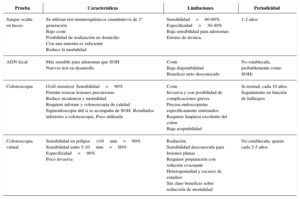
Los programas de detección precoz mediante la implantación de un cribado en poblaciones de riesgo medio ha demostrado ser coste-eficaces, con un descenso de la mortalidad por CCR entre el 30-70%. La colonoscopia es el método más sensible y específico pero su limitada aceptación y su elevado coste han llevado a que estos programas inicien el cribado mediante la prueba inmunoquímica para sangre oculta en heces.

Tratamiento

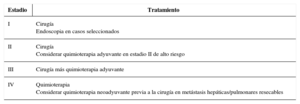
La cirugía sigue siendo el tratamiento más efectivo, precedida de quimio-radioterapia en el cáncer de recto localmente avanzado. La quimioterapia ha demostrado mejorar la supervivencia y la calidad de vida en los estadios III y IV. En esta revisión actualizamos los aspectos moleculares, epidemiológicos, diagnósticos y terapéuticos más relevantes de esta patología.

Palabras clave
Cáncer colorrectal
Pólipo adenomatoso
Detección precoz
Colonoscopia
Sangre oculta en heces
Tratamiento
Abstract
Epidemiology

Colorectal cancer (CRC) is the most common malignancy in Spain and the third worldwide. Approximately 80% are sporadic, 20% exhibit familial clustering and 5% occur within a well-defined hereditary syndrome.

Pathogeny

Although sometimes CRC originates from a previously healthy colonic mucosa, in most cases CRC arises from malignant transformation of an adenomatous polyp.

Diagnosis

Screening in average-risk populations has proven to decline mortality by 30-70% and to be cost-effective. Colonoscopy is the most sensitive and specific method but its limited acceptance and high cost have positioned immunological faecal occult blood testing as the initial procedure in screening programs.

Treatment

Surgery remains the most effective treatment preceded by chemoradiotherapy in locally advanced rectal cancer. Chemotherapy has been shown to improve overall survival and quality of life in stages III and IV. In this review we update the most relevant molecular, epidemiological, diagnostic and therapeutic aspects of this entity.

Keywords
Colorectal cancer
Adenomatous polyp
Screening
Colonoscopy
Faecal occult blood
Treatment

Identifíquese

¿Aún no es suscriptor de la revista?

Comprar el acceso al artículo

Comprando el artículo el pdf del mismo podrá ser descargado

Teléfono para incidencias

De lunes a viernes de 9h a 18h (GMT+1) excepto los meses de julio y agosto que será de 9 a 15h

Llamadas desde España 932 415 960
Llamadas desde fuera de España +34 932 415 960
Bibliografía
[1]
International Agency for Research on Cancer. World Health Organisation. 2015. [Consultado Septiembre 2015, 2015]. Disponible en: http://globocan.iarc.fr/Pages/burden_sel.aspx.
[2]
E.H. Schreuders, A. Ruco, L. Rabeneck, R.E. Schoen, J.J. Sung, G.P. Young, et al.
Colorectal cancer screening: a global overview of existing programmes.
Gut., (2015), 64 pp. 1637-1649
[3]
F. Bray, J. Ferlay, M. Laversanne, D.H. Brewster, C. Gombe Mbalawa, B. Kohler, et al.
Cancer incidence in five continents: inclusion criteria, highlights from volume X and the global status of cancer registration.
Int J Cancer, (2015), 137 pp. 2060-2071
[4]
Grupo de trabajo de la guía de práctica clínica de prevención del cáncer colorrectal. Guía de práctica clínica. Barcelona: Asociación Española de Gastroenterología, Sociedad Española de Medicina de Familia y Comunitaria y Centro Cochrane Iberoamericano 2009.
[5]
M. Bardou, A.N. Barkun, M. Martel.
Obesity and colorectal cancer.
[6]
A.G. Renehan, M. Tyson, M. Egger, R.F. Heller, M. Zwahlen.
Body-mass index and incidence of cancer: a systematic review and meta-analysis of prospective observational studies.
[7]
E. Botteri, S. Iodice, V. Bagnardi, S. Raimondi, A.B. Lowenfels, P. Maisonneuve.
Smoking and colorectal cancer: a meta-analysis.
JAMA, (2008), 300 pp. 2765-2778
[8]
V. Fedirko, I. Tramacere, V. Bagnardi, M. Rota, L. Scotti, F. Islami, et al.
Alcohol drinking and colorectal cancer risk: an overall and dose-response meta-analysis of published studies.
Ann Oncol, (2011), 22 pp. 1958-1972
[9]
L. Deng, Z. Gui, L. Zhao, J. Wang, L. Shen.
Diabetes mellitus and the incidence of colorectal cancer: an updated systematic review and meta-analysis.
Dig Dis Sci., (2012), 57 pp. 1576-1585
[10]
D.A. Kennedy, S.J. Stern, M. Moretti, I. Matok, M. Sarkar, C. Nickel, et al.
Folate intake and the risk of colorectal cancer: a systematic review and meta-analysis.
Cancer Epidemiol, (2011), 35 pp. 2-10
[11]
R.C. Heine-Bröring, R.M. Winkels, J. Renkema, L. Kragt, A.C. van Orten-Luiten, E.F. Tigchelaar, et al.
Dietary supplement use and colorectal cancer risk: A systematic review and meta-analyses of prospective cohort studies.
Int J Cancer, (2015), 136 pp. 2388-2401
[12]
Y. Ma, P. Zhang, F. Wang, J. Yang, Z. Liu, H. Qin.
Association between vitamin D and risk of colorectal cancer: a systematic review of prospective studies.
J Clin Oncol, (2011), 29 pp. 3775-3782
[13]
G. Bjelakovic, D. Nikolova, R.G. Simonetti, C. Gluud.
Systematic review: primary and secondary prevention of gastrointestinal cancers with antioxidant supplements.
Aliment Pharmacol Ther, (2008), 28 pp. 689-703
[14]
E. Flossmann, P.M. Rothwell.
Effect of aspirin on long-term risk of colorectal cancer: consistent evidence from randomised and observational studies.
Lancet, (2007), 369 pp. 1603-1613
[15]
H. Nan, C.M. Hutter, Y. Lin, E.J. Jacobs, C.M. Ulrich, E. White, et al.
Association of aspirin and NSAID use with risk of colorectal cancer according to genetic variants.
JAMA, (2015), 313 pp. 1133-1142
[16]
T. Lytras, G. Nikolopoulos, S. Bonovas.
Statins and the risk of colorectal cancer: an updated systematic review and meta-analysis of 40 studies.
World J Gastroenterol, (2014), 20 pp. 1858-1870
[17]
Feldman M, Friedman LS, Brandt LJ. Sleisenger and Fordtran's gastrointestinal and liver disease: pathophysiology, diagnosis, management: Elsevier Health Sciences; 2015.
[18]
C.S. Potten, M. Kellett, S.A. Roberts, D. Rew, G. Wilson.
Measurement of in vivo proliferation in human colorectal mucosa using bromodeoxyuridine.
Gut., (1992), 33 pp. 71-78
[19]
H. Raskov, H.C. Pommergaard, J. Burcharth, J. Rosenberg.
Colorectal carcinogenesis-update and perspectives.
World J Gastroenterol, (2014), 20 pp. 18151-18164
[20]
U. Peters, S. Bien, N. Zubair.
Genetic architecture of colorectal cancer.
Gut., (2015), 64 pp. 1623-1636
[21]
F.M. Giardiello, J.I. Allen, J.E. Axilbund, C.R. Boland, C.A. Burke, R.W. Burt, et al.
Guidelines on genetic evaluation and management of Lynch syndrome: a consensus statement by the US Multi-Society Task Force on Colorectal Cancer.
Gastroenterology, (2014), 147 pp. 502-526
[22]
I.J. JE, L. Vermeulen, G.A. Meijer, E. Dekker.
Serrated neoplasia-role in colorectal carcinogenesis and clinical implications.
Nat Rev Gastroenterol Hepatol, (2015), 12 pp. 401-409
[23]
K.W. Jasperson, T.M. Tuohy, D.W. Neklason, R.W. Burt.
Hereditary and familial colon cancer.
Gastroenterology, (2010), 138 pp. 2044-2058
[24]
E.J. Gardner, R.C. Richards.
Multiple cutaneous and subcutaneous lesions occurring simultaneously with hereditary polyposis and osteomatosis.
Am J Hum Genet, (1953), 5 pp. 139-147
[25]
J. Turcot, J.P. Despres, F. St Pierre.
Malignant tumors of the central nervous system associated with familial polyposis of the colon: report of two cases.
Dis Colon Rectum, (1959), 2 pp. 465-468
[26]
E.M. Stoffel, P.B. Mangu, P.J. Limburg.
Hereditary colorectal cancer syndromes: American Society of Clinical Oncology clinical practice guideline endorsement of the familial risk-colorectal cancer: European Society for Medical Oncology clinical practice guidelines.
J Oncol Pract, (2015), 11 pp. e437-e441
[27]
J. Balmana, F. Balaguer, A. Cervantes, D. Arnold.
Familial risk-colorectal cancer: ESMO Clinical Practice Guidelines.
Ann Oncol, (2013), 24 pp. vi73-vi80
[28]
S. Yamaguchi, H. Ogata, D. Katsumata, M. Nakajima, T. Fujii, S. Tsutsumi, et al.
MUTYH-associated colorectal cancer and adenomatous polyposis.
Surg Today, (2014), 44 pp. 593-600
[29]
D.A. Lieberman.
Clinical practice. Screening for colorectal cancer.
N Engl J Med, (2009), 361 pp. 1179-1187
[30]
R. Labianca, B. Nordlinger, G.D. Beretta, S. Mosconi, M. Mandalà, A. Cervantes, et al.
ESMO Guidelines Working Group. Early colon cancer: ESMO Clinical Practice Guidelines for diagnosis, treatment and follow-up.
Ann Oncol, (2013), 24 pp. vi64-vi72
[31]
C.D. Johnson, M.H. Chen, A.Y. Toledano, J.P. Heiken, A. Dachman, M.D. Kuo, et al.
Accuracy of CT colonography for detection of large adenomas and cancers.
N Engl J Med, (2008), 359 pp. 1207-1217
[32]
B. Glimelius, E. Tiret, A. Cervantes, D. Arnold.
Rectal cancer: ESMO Clinical Practice Guidelines for diagnosis, treatment and follow-up.
Ann Oncol, (2013), 24 pp. vi81-vi88
[33]
L. Lorenzon, M. La Torre, V. Ziparo, F. Montebelli, P. Mercantini, G. Balducci, et al.
Evidence based medicine and surgical approaches for colon cancer: evidences, benefits and limitations of the laparoscopic vs open resection.
World J Gastroenterol, (2014), 20 pp. 3680-3692
[34]
A.B. Benson 3rd, A.P. Venook, T. Bekaii-Saab, E. Chan, Y.J. Chen, H.S. Cooper, et al.
Colon cancer, version 3.2014.
J Natl Compr Canc Netw, (2014), 12 pp. 1028-1059
[35]
C. Clancy, J.P. Burke, M.R. Albert, P.R. O’Connell, D.C. Winter.
Transanal endoscopic microsurgery versus standard transanal excision for the removal of rectal neoplasms: a systematic review and meta-analysis.
Dis Colon Rectum, (2015), 58 pp. 254-261
[36]
E. Van Cutsem, A. Cervantes, B. Nordlinger, D. Arnold.
ESMO Guidelines Working Group. Metastatic colorectal cancer: ESMO Clinical Practice Guidelines for diagnosis, treatment and follow-up.
Ann Oncol, (2014), 25 pp. iii1-iii9
[37]
J. Ruiz-Tovar, J. Jiménez-Miramón, A. Valle, M. Limones.
Endoscopic resection as unique treatment for early colorectal cancer.
Rev Esp Enferm Dig, (2010), 102 pp. 435-441
[38]
D.A. Fisher, A.K. Shergill, D.S. Early, R.D. Acosta, V. Chandrasekhara, K.V. Chathadi, ASGE Standards of Practice Committee, et al.
Role of endoscopy in the staging and management of colorectal cancer.
Gastrointes Endosc, (2013), 78 pp. 8-12
[39]
J.E. van Hooft, E.E. van Halsema, G. Vanbiervliet, R.G. Beets-Tan, J.M. DeWitt, F. Donnellan, et al.
Self-expandable metal stents for obstructing colonic and extracolonic cancer: European Society of Gastrointestinal Endoscopy (ESGE) Clinical Guideline.
Gastrointest Endoscop, (2014), 80 pp. 747-761
[40]
G. Lanza, R. Gafa, A. Santini, I. Maestri, L. Guerzoni, L. Cavazzini.
Immunohistochemical test for MLH1 and MSH2 expression predicts clinical outcome in stage II and III colorectal cancer patients.
J Clin Oncol, (2006), 24 pp. 2359-2367
[41]
S. Pita-Fernández, M. Alhayek-Ai, C. González-Martín, B. López-Calvino, T. Seoane-Pillado, S. Pertega-Díaz.
Intensive follow-up strategies improve outcomes in nonmetastatic colorectal cancer patients after curative surgery: a systematic review and meta-analysis.
Ann Oncol, (2015), 26 pp. 644-656
[42]
S.D. Ramsey, K. Berry, C. Moinpour, A. Giedzinska, M.R. Andersen.
Quality of life in long term survivors of colorectal cancer.
American J Gastroenterol, (2002), 97 pp. 1228-1234