


Vol. 12. Núm. 6.
Páginas 285-296 (Marzo 2016)

Actualización
Enfermedad diverticular del colon

Diverticular disease of the colon

M. Aicart-RamosabF. MesoneroabS. ParejoabB. Peñasab
Doi : https://10.1016/j.med.2016.03.002
Opciones
Resumen
Introducción

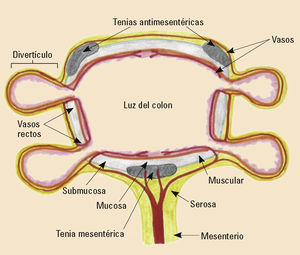
Los divertículos son un trastorno anatómico adquirido a consecuencia de la hiperpresión y al aumento de motilidad del colon, con influencia de factores ambientales como el consumo de fibra.

Manifestaciones clínicas

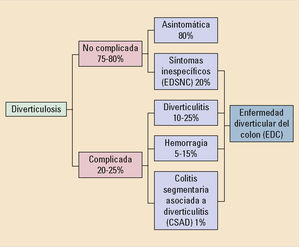
Con predominio en Occidente, la mayoría de los casos se mantienen asintomáticos. Sin embargo, pueden implicar un amplio abanico de patologías: enfermedad diverticular sintomática no complicada, diverticulitis, hemorragia o colitis segmentaria.

Diagnóstico

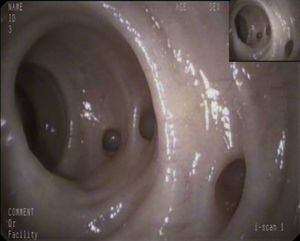
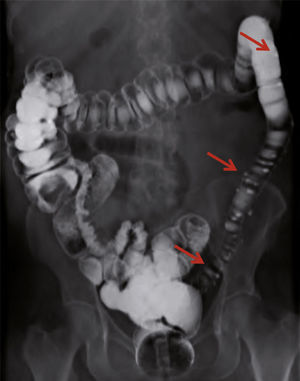
El diagnóstico en la mayoría de los cuadros se basa en la colonoscopia, salvo en la diverticulitis, donde se recurre a la TC o ecografía.

Tratamiento

El manejo es muy variado según el tipo de presentación: desde el consumo de fibra, antibióticos no absorbibles o 5-aminosalicilatos en las no complicadas y en la colitis, a la antibioterapia de amplio espectro o el tratamiento endoscópico en la diverticulitis o hemorragia. Debido a un manejo cada vez más conservador, la cirugía está siendo sustituida por el intervencionismo radiológico como tratamiento de rescate.

Palabras clave
Diverticulosis
Diverticulitis
Hemorragia diverticular
Abstract
Introduction

Diverticula are anatomic acquired disorders that appear secondary to high pressure and alteration of colon motility, influenced by environmental factors like fiber intake.

Clinical manifestations

They predominate in Western population, most of them asymptomatic. However they are implicated in several different disorders: symptomatic uncomplicated diverticular disease, diverticulitis, hemorrhage and segmental colitis.

Diagnosis

Colonosocopy is the most important diagnostic procedure, except CT or ultrasonography in case of diverticulitis.

Treatment

Treatment varies depending of the form of presentation: from fiber, nonabsorbable antibiotics or 5-aminosalicylic acid if colitis or uncomplicated disease, to broad spectrum antibiotics or endoscopic treatment if diverticulitis or hemorrhage. Because of a trend to conservative management, interventional radiology is replacing surgery as a rescue treatment.

Keywords
Diverticulosis
Diverticulitis
Diverticular hemorrhage

Identifíquese

¿Aún no es suscriptor de la revista?

Comprar el acceso al artículo

Comprando el artículo el pdf del mismo podrá ser descargado

Teléfono para incidencias

De lunes a viernes de 9h a 18h (GMT+1) excepto los meses de julio y agosto que será de 9 a 15h

Llamadas desde España 932 415 960
Llamadas desde fuera de España +34 932 415 960
Bibliografía
[1]
E. Moreno-Osset, F. Mora Miguel.
Enfermedad diverticular de colon.
Tratamiento de las enfermedades gastroenterológicas, 3ª ed., AstraZeneca, pp. 175-187
[2]
Bhuket TP, Stollman NH. Diverticular disease of the colon. En: Feldman, M., (eds.), Sleisenger and Fordtran's gastrointestinal and liver disease. 10th ed. Philadelphia: Elsevier; 2123-38.
[3]
J.S. Gear, A. Ware, P. Fursdon, J.I. Mann, D.J. Nolan, A.J. Brodribb, et al.
Symptomless diverticular disease and intake of dietary fibre.
[4]
A.F. Peery, P.R. Barrett, D. Park, A.J. Rogers, J.A. Galanko, C.F. Martin, et al.
A high-fiber diet does not protect against asymptomatic diverticulosis.
Gastroenterology, (2012), 142 pp. 266-272
[5]
L.L. Strate, Y.L. Liu, S. Syngal, W.H. Aldoori, E.L. Giovannucci.
Nut, corn, and popcorn consumption and the incidence of diverticular disease.
JAMA, (2008), 300 pp. 907-914
[6]
L.L. Strate, R. Erichsen, J.A. Baron, J. Mortensen, J.K. Pedersen, A.H. Riis, et al.
Heritability and familial aggregation of diverticular disease: A population based study of twins and siblings.
Gastroenterology, (2013), 144 pp. 736-742
[7]
J. Granlund, T. Svensson, O. Olén, F. Hjern, N.L. Pedersen, P.K. Magnusson, et al.
The genetic influence on diverticular disease.
A twin study. Aliment Pharmacol Ther, (2012), 35 pp. 1103-1107
[8]
S. Jun, N. Stollman.
Epidemiology of diverticular disease.
Best Pract Res Clin Gastroenterol, (2002), 16 pp. 529-542
[9]
C.J. Gargallo Puyuelo, F. Sopeña, A. Lanas Arbeloa.
Colonic diverticular disease. Tratment and prevention.
Gastroenterol Hepatol. En prensa, (2015),
[10]
W.H. Aldoori, E.L. Giovannucci, H.R. Rockett, L. Sampson, E.B. Rimm, W.C. Willett.
A prospective study of dietary fiber types and symptomatic diverticular disease in men.
J Nutr, (1998), 128 pp. 714-719
[11]
G.A. Binda, R. Cuomo, A. Laghi, R. Nascimbeni, A. Serventi, D. Bellini, et al.
Practive parameters for the treatment of colonic diverticular disease: Italian Society of Colon and Rectal Surgery (SICCR) guidelines.
Tech Coloproctol, (2015), 19 pp. 615-626
[12]
C.M. Brayko, R.A. Kozarek, R.A. Sanowski, T. Howells.
Diverticular rupture during colonoscopy.
Fact or fancy? Dig Dis Sci., (1984), 29 pp. 427-431
[13]
A. Tursi, G. Brandimarte, W. Elisei, G.M. Giorgetti, C.D. Inchingolo, F. Aiello.
Faecal calprotectin in diverticular disease: a case control study.
Int J Colorectal Dis, (2009), 24 pp. 49-55
[14]
A. Tursi, A. Papa, S. Danese.
Review article: the pathophysiology and medical management of diverticulossi adn diverticular disease of the colon.
Aliment Pharmacol Ther, (2015), 42 pp. 664-684
[15]
C. Unlu, L. Daniels, B.C. Vrouenraets, M.A. Boermeester.
A systematic review of high-fiber dietary therapy in diverticular disease.
Int J Colorectal Dis, (2012), 27 pp. 419-427
[16]
M. Bianchi, V. Festa, A. Moretti, A. Ciaco, M. Mangone, V. Tornatore, et al.
Meta-analysis: longterm therapy with rifaximin in the management of uncomplicated diverticular disease.
Aliment Pharmacol Ther, (2011), 33 pp. 902-910
[17]
RoccoA, D. Compare, F. Caruso, G. Nardone.
Treatment options for uncomplicated diverticular disease of the colon.
J Clin Gastroenterol, (2009), 43 pp. 803-808
[18]
W. Kruis, E. Meier, M. Schumacher, O. Mickisch, R. Greinwald, R. Mueller.
German SAG-20 Study Group. Randomised clinical trial: Mesalazine (Salofalk granules) for uncomplicated diverticular disease of the colon; a placebo-controlled study.
Aliment Pharmacol Ther, (2013), 37 pp. 680-690
[19]
S. Vennix, D.G. Morton, J. Hahnloser, on behalf of the research committee of the European Society of Coloproctology, et al.
Systematic review of evidence and consensus on diverticulitis: an analysis of national and international guidelines.
Col Dis, (2014), 16 pp. 866-878
[20]
N.H. Stollman, J.B. Raskin.
Diagnosis and management of diverticular disease of the colon in adults. Ad hoc practice parameters committee of the American College of Gastroenterology.
Am J Gastroenterol, (1999), 94 pp. 3110-3121
[21]
C.S. Andeweg, J.A. Wegdam, J. Groenewoud, G.J. van der Wilt, H. van Goor, R.P. Bleichrodt.
Toward an evidence-based step-up approach in diagnosing diverticulitis.
Scand J Gastroenterol, (2014), 49 pp. 775-784
[22]
A.G. Schreyer, G. Layer.
Guidelubes for diverticular disease and diverticulitis: diagnosis, classification and therapy for the radiologist.
Fortschr Röntegenstr, (2015), 187 pp. 676-684
[23]
A. Tursi.
Colonoscopy in acute diverticulitis: When and why.
J Clin Gastroenterol, (2012), 46 pp. 621-622
[24]
J. Rafferty, P. Shellito, N.H. Hyman, W.D. Buie.
Standards Committee of American Society of Colon and Rectal Surgeons. Practice parameters for sigmoid diverticulitis.
Dis Colon Rectum, (2006), 49 pp. 939-944
[25]
V.F. Sai, F. Velayos, J. Neuhaus, A.C. Westphalen.
Colonoscopy after CT diagnosis of diverticulitis to exclude colon cancer: A systematic literature review.
Radiology, (2012), 263 pp. 383-390
[26]
S. Mosadeghi, T. Bhuket, N. Stolllman.
Diverticular disease: evolving concepts in classification, presentation and management.
Curr Opin Gastroenterol, (2015), 31 pp. 50-55
[27]
P. Anglade, D. Gelrud, A. Milillo, D. Mishkin.
Is a recent episode of diverticulitis an acceptable indication for colonoscopy? [abstr].
Gastrointest Endosc, (2004), 59 pp. 266
[28]
S. Biondo, T. Golda, E. Kreisler, E. Espin, F. Vallribera, F. Oteiza, et al.
Outpatients versus hospitalisation management for uncomplicated diverticulitis: a prospective, multicenter randomised clinical trial (DIVER Trial).
[29]
F. Hjern, T. Josephson, D. Altman, et al.
Conservative treatment of acute colonic diverticulitis: Are antibiotics always mandatory?.
Scand J Gastroenterol, (2007), 42 pp. 41-44
[30]
M.N. Lamb, A.M. Kaiser.
Elective resection versus observation after nonoperative management of complicated diverticulitis with abscess: a systematic review and meta-analysis.
Dis Colon Rectum, (2014), 57 pp. 1430-1440
[31]
J.R. Chapman, E.J. Dozois, B.G. Wolff, R.E. Gullerud, D.R. Larson.
Diverticulitis: A progressive disease? Do multiple recurrences predict less favorable outcomes?.
[32]
C. Unlü, L. Daniels, B.C. Vrouenraets, M.A. Boermeester.
Systematic review of medical therapy to prevent recurrent diverticulitis.
Int J Colorectal Dis, (2012), 27 pp. 1131-1136
[33]
S.K. Wong, Y.H. Ho, A.P. Leong, F. SeowChoen.
Clinical behavior of complicated rightsided and leftsided diverticulosis.
Dis Colon Rectum, (1997), 40 pp. 344-348
[34]
T. Rustagi, T.R. McCarty.
Endoscopic management of diverticular bleeding.
Gastroenterol Res Pra, (2014), pp. 353508
[35]
D. Collins, D.C. Winter.
Modern concepts in diverticular disease.
J Clin Gastroenterol, (2015), 49 pp. 358-367
[36]
R. Loffroy, C.T. Multidetector.
angiography for the detection of colonic diverticular bleeding: when, how, and why?.
Dig Dis Sci, (2013), 58 pp. 1822-1824
[37]
L.W. Lamps, W.L. Knapple.
Diverticular disease associated segmental colitis.
Clin Gastroenterol Hepatol, (2007), 5 pp. 27-31
[38]
N.S. Mann, K.K. Hoda.
Segmental colitis associated with diverticulosis: Systematic evaluation of 486 cases with metaanalysis.
Hepatogastroenterology, (2012), 59 pp. 2119-2121
[39]
H.J. Freeman.
Natural history and long term clinical behavior of segmental colitis associated with diverticulosis.
Dig Dis Sci, (2008), 53 pp. 2452-2457