

Vol. 12. Núm. 2.
Páginas 57-65 (Febrero 2016)

Actualización
Dispepsia. Clasificación y manejo diagnóstico-terapéutico

Dyspepsia. Diagnostic-therapeutic classification and management

A. BordaF. Estremera
Doi : https://10.1016/j.med.2016.01.010
Opciones
Resumen
Introducción

La dispepsia es un término que agrupa un conjunto heterogéneo de síntomas que tienen su origen en el abdomen superior, siendo considerada una causa frecuente de consulta.

Etiopatogenia

En la mayor parte de los pacientes es catalogada de origen funcional. Su fisiopatología no está aclarada, englobando múltiples mecanismos como enlentecimiento del vaciamiento gástrico, hipersensibilidad visceral, presencia de infección por Helicobacter pylori o factores ambientales o genéticos.

Diagnóstico

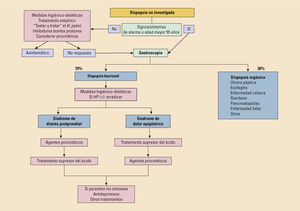
La historia clínica continúa siendo un arma clave para definir la estrategia terapéutica a seguir, que nos llevará a realizar una gastroscopia inicialmente, en función de la edad del paciente y la existencia de síntomas de alarma.

Tratamiento

En caso contrario, el planteamiento de testar la presencia de H. pylori mediante pruebas no agresivas se considera aceptado en nuestro medio, realizando tratamiento antisecretor o antidepresivo en los casos en los que no se demuestre infección o recidiven o persistan los síntomas tras la erradicación.

Palabras clave
Dispepsia no investigada
Dispepsia orgánica
Dispepsia funcional
Helicobacter pylori
Abstract
Introduction

Dyspepsia brings together a diverse set of symptoms that have their origin in the upper abdomen, and is considered a common cause of consultation.

Aetiopathogenesis

Most of the patients are listed functional origin. Its pathophysiology is unclear, encompassing multiple mechanisms as slow gastric emptying, visceral hypersensitivity, presence of Helicobacter pylori infection or genetic or environmental factors.

Diagnosis

The history remains a key weapon to define the therapeutic strategy that will take us to perform a gastroscopy initially, depending on the patient's age and the existence of warning signs.

Treatment

Otherwise, the approach to test for the presence of H. pylori using aggressive testing is considered not accepted in our environment, making antisecretory therapy or antidepressant in cases where no proven infection or recidiven or symptoms persist after eradication.

Keywords
Uninvestigated dyspepsia
Organic dyspepsia
Functional dyspepsia
Helicobacter pylori

Identifíquese

¿Aún no es suscriptor de la revista?

Comprar el acceso al artículo

Comprando el artículo el pdf del mismo podrá ser descargado

Teléfono para incidencias

De lunes a viernes de 9h a 18h (GMT+1) excepto los meses de julio y agosto que será de 9 a 15h

Llamadas desde España 932 415 960
Llamadas desde fuera de España +34 932 415 960
Bibliografía
[1]
H.B. El-Serag, N.J. Talley.
Systematic review: the prevalence and clinical course of functional dyspepsia.
Alim Pharmacol Pharm Ther., (2004), 19 pp. 643-654
[2]
A.P. Hungin, C. Hill, A. Raghunath.
Systematic review: frequency and reasons for consultation for gastro-oesophageal reflux disease and dyspepsia.
Aliment Pharmacol Ther., (2009), 30 pp. 331-342
[3]
B.E. Lacy, K.T. Weiser, A.T. Kennedy, M.D. Crowell, N.J. Talley.
Functional dyspepsia: the economic impact to patients.
Aliment Pharmacol Ther., (2013), 38 pp. 170-177
[4]
J. Tack, N.J. Talley, M. Camillieri, G. Holtmann, P. Hu, J.R. Malagelada, et al.
Functional gastroduodenal disorders.
Gastroenterology., (2006), 130 pp. 1466-1479
[5]
F. Carbone, L. Holvoet, J. Tack.
Rome III functional dyspepsia subdivision in PDS and EPS: recognizing postprandial symptoms reduces overlap.
Neurogastroenterol Motil., (2015), 27 pp. 1069-1074
[6]
P. Moayyedi, N.J. Talley, M.B. Fennerty, N. Vakil.
Can the clinical history distinguish between organic and functional dyspepsia?.
JAMA., (2006), 295 pp. 1566-1576
[7]
J.P. Gisbert, Atención, Primaria.
Guía de práctica clínica sobre el manejo del paciente con dyspepsia.
Actualización 2012. Aten Primaria., (2012), 44 pp. 727-738
[8]
N.J. Talley.
Guidelines for the management of dyspepsia.
Am J Gastroenterol., (2005), 100 pp. 2324-2337
[9]
S. Miguélez, M. Cornide, E. Martínez.
Cáncer gástrico en el Hospital General de Segovia (2005-2008).
Gastroenterol Hepatol., (2012), 35 pp. 684-690
[10]
J.I. Allen, D. Katzka, M. Robert, G.I. Leontiadis.
American Gastroenterological Association institute technical review of the role of upper gastrointestinal biopsy to evaluate dyspepsia in the adult patient in the absence of visible mucosal lesions.
Gastroenterology., (2015), 149 pp. 1088-1118
[11]
U. Ladabaum, W.D. Chey, J.M. Scheiman, A.M. Fendrick.
Reappraisal of non-invasive management strategies for uninvestigated dyspepsia: a cost-minimization analysis.
Aliment Pharmacol Ther., (2002), 16 pp. 1491-1501
[12]
W.H. Wang, J.Q. Huang, G.F. Zheng, H.H. Xia, W.M. Wong, et al.
Effects of proton pump inhibitors on functional dyspepsia: a meta-analysis of randomized placebo-controlled trials.
Clin Gastroenterol Hepatol., (2007), 5 pp. 172-185
[13]
A.C. Ford, A. Marwaha, A. Lim, P. Moayyedi.
What is the prevalence of clinically significant endoscopic findings in subjects with dyspepsia?.
Systematic review and meta-analysis. Clin Gastroenterol Hepatol., (2010), 8 pp. 830-837
[14]
A. Lanas, B.I. Hirschowitz.
Toxicity of NSAIDs in the stomach and duodenum.
Eur J Gastroenterol Hepatol., (1999), 11 pp. 375-381
[15]
J. Tack, P. Caenepeel, J. Arts, K.J. Lee, D. Sifrim, J. Janssens.
Prevalence of acid reflux in functional dyspepsia and its association with symptom profile.
Gut., (2005), 54 pp. 1370-1376
[16]
N.J. Talley, E.H. Dennis, V.A. Schettler-Duncan, B.E. Lacy, K.W. Olden, M.D. Crowell, et al.
Overlapping upper and lower gastrointestinal symptoms in Irritable Bowel Symdrome patients with constipation or diarrhea.
Am J Gastroenterol., (2003), 98 pp. 2454-2459
[17]
S.E. Kim, L. Chang.
Overlap between functional GI disorders and other functional syndromes: what are the underlying mechanisms?.
Neurogastroenterol Motil., (2012), 24 pp. 895-913
[18]
K. Mimidis, J. Tack.
Pathogenesis of dyspepsia.
Dig Dis., (2008), 26 pp. 94-202
[19]
M.P. Jones, S. Hoffman, D. Shah, K. Patel, C.C. Ebert.
The water load test: observations from healthy controls and patients with functional dyspepsia.
Am J Physiol Gastrointest Liver Physiol., (2003), 84 pp. 896-904
[20]
K. Tominaga, C. Tsumoto, S. Ataka, K. Mizuno 4, K. Takahashi, H. Yamagami, et al.
Regional brain disorders of serotonin neurotransmission are associated with functional dispepsia.
Life Sci., (2015), 137 pp. 150-157
[21]
P. Bercik, L. De Giorgio, P. Blennerhassett, E.F. Verdú, G. Barbara, S.M. Collins.
Immune-mediated neural dysfunction in a murine model of chronic helicobacter pylori infection.
Gastroenterology., (2002), 123 pp. 1205-1215
[22]
R. Buonavolonta, P. Coccorullo, R. Turco, G. Boccia, L. Greco, A. Staiano.
Familial aggregation in children affected by functional gastrointestinal Disorders.
J Pediatr Gastroenterol Nutr., (2010), 50 pp. 500-505
[23]
E.A. Mayer.
The neurobiology of stress and gastrointestinal disease.
Gut., (2000), 47 pp. 861-869
[24]
F. Mearin, M. Pérez-Oliveras, A. Perelló, J. Vinyet, A. Ibañez, J. Coderch, et al.
Dyspepsia and irritable bowell syndrome after a Salmonella gastroenteritis outbreak: One-year follow-up cohort study.
Gastroenterology., (2005), 129 pp. 98-104
[25]
T. Liebregts, B. Adam, C. Bredack, M. Gururatsakul, K.R. Pilkington, S.M. Brierley, et al.
Small bowell homing T cells are associated with symptoms and delayed gastric empting in functional dyspepsia.
Am J Gastroenterol., (2011), 106 pp. 1089-1098
[26]
M. Ochi, K. Tominaga, T. Iketani, K. Kadouchi, T. Tanigawa, M. Shiba, et al.
Perfectionism underlying psychological background correlated with the symptoms of functional dyspepsia.
J Gastroenterol., (2008), 43 pp. 699-704
[27]
K. Togawa, J. Matsuzaki, M. Kobayakawa, Y. Fukushima, F. Suzaki, K. Kasugai, et al.
Association of baseline plasma des-acyl ghrelin level with the response to rikkunshito in patients with Functional Dyspepsia.
J Gastroenterol Hepatol. En prensa, (2015),
[28]
M.K. Overland.
Dyspepsia.
Med Clin N Am., (2014), 98 pp. 549-564
[29]
P. Moayyedi, S. Soo, J.J. Deeks, B. Delaney, A. Harris, M. Innes, et al.
Eradication of Helicobacter pylori for non-ulcer dyspepsia.
Cochrane Database Syst Rev., (2006),
[30]
H. Vanheel, J. Tack.
Therapeutic options for functional dyspepsia.
Dig Dis., (2014), 32 pp. 230-234
[31]
G. Xiao, X. Xie, J. Fan, J. Deng, S. Tan, Y. Zhu, et al.
Efficacy and safety of acotiamide for the treatment of functional dyspepsia: systematic review and meta-analysis.
Scientific World Journal., (2014), 2014 pp. 541950
[32]
S.H. Sindrup, M. Otto, N.B. Finnerup, T.S. Jensen.
Antidepressants in the treatment of neuropathic pain.
Basic Clin Pharmacol Toxicol., (2005), 96 pp. 399-409
[33]
N.J. Talley, G.R. Locke, Y.A. Saito, A.E. Almazar, E.P. Bouras, C.W. Howden, et al.
Effect of amitriptyline and escitalopram on functional dyspepsia: a multicenter, randomized controlled study.
Gastroenterology., (2015), 149 pp. 340-349
[34]
J.J. Sebastián-Domingo.
La medicina integrativa en el manejo de la dispepsia funcional. Papel del preparado herbal STW5.
Gastroenterol Hepatol., (2014), 37 pp. 256-261