

Vol. 12. Núm. 2.
Páginas 66-73 (Febrero 2016)

Actualización
Gastritis

Gastritis

R. Angós
Doi : https://10.1016/j.med.2016.01.011
Opciones
Resumen
Introducción

Aunque el término gastritis define la inflamación microscópica de la mucosa gástrica, también incluye otras definiciones clínicas, endoscópicas y radiológicas variadas. En los pacientes con gastritis suele haber muy poca correlación entre los síntomas, los hallazgos endoscópicos y los hallazgos histológicos.

Etiopatogenia

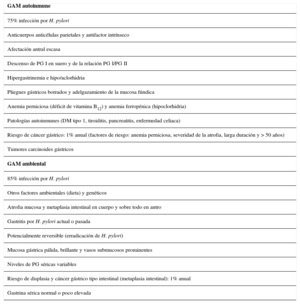
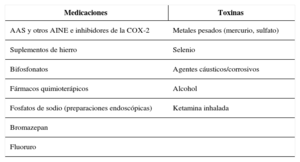
La causa más frecuente de gastritis crónica es la infección por H. pylori seguida por las gastritis atróficas. Las gastropatías reactivas son la tercera causa de agresión de la mucosa gástrica y, dentro de ellas, destacan las producidas por la toma de ácido acetilsalicílico y otros AINE. Además de H. pylori, existen otros gérmenes que pueden contaminar el estómago y producir gastritis infecciosas.

Diagnóstico

La realización de biopsias gástricas a diversos niveles es fundamental para el diagnóstico de certeza de los diversos tipos de gastritis. La mayor parte de los cánceres gástricos tiene su origen en algunos tipos concretos de gastritis.

Tratamiento

Los tratamientos son variables según su etiopatogenia.

Palabras clave
Gastritis
Gastropatía reactiva
Atrofia gástrica
Metaplasia
Abstract
Introduction

Although the term gastritis defined microscopic inflammation of the gastric mucosa, also it includes other various clinical, endoscopic and radiologic definitions. In patients with gastritis usually very little correlation between symptoms, endoscopic findings and histological findings.

Aetiopathogenesis

The most common cause of chronic gastritis is Helicobacter pylori infection followed by atrophic gastritis. Reactive gastropathies are the third leading cause of aggression of gastric mucosa and within them include those produced by taking aspirin and other NSAIDs. In addition H. pylori other germs that can contaminate the stomach and cause gastritis are infectious.

Diagnosis

Performing gastric biopsies at different levels is crucial for accurate diagnosis of the various types of gastritis. The majority of gastric cancers originated in specific types of gastritis.

Treatment

Treatments vary according to its pathogenesis.

Keywords
Gastritis
Reactive gastropathy
Gastric atrophy
Metaplasia

Identifíquese

¿Aún no es suscriptor de la revista?

Comprar el acceso al artículo

Comprando el artículo el pdf del mismo podrá ser descargado

Teléfono para incidencias

De lunes a viernes de 9h a 18h (GMT+1) excepto los meses de julio y agosto que será de 9 a 15h

Llamadas desde España 932 415 960
Llamadas desde fuera de España +34 932 415 960
Bibliografía
[1]
H.A. Carpenter, N.J. Talley.
Gastroscopy is incomplete without biopsy: clinical relevance of distinguishing gastropathy from gastritis.
Gastroenterology., (1995), 108 pp. 917-924
[2]
M.F. Dixon, R.M. Genta, J.H. Yardley, P. Correa, Classification and grading of gastritis.
The updated Sydney System. International Workshop on the Histopathology of Gastritis, Houston 1994.
Am J Surg Pathol., (1996), 20 pp. 1161-1181
[3]
M. Rugge, A. Meggio, G. Pennelli, F. Piscioli, L. Giacomelli, G. De Pretis, et al.
Gastritis staging in clinical practice: the OLGA staging system.
Gut., (2007), 56 pp. 631-636
[4]
K. Sugano, J. Tack, E.J. Kuipers, D.Y. Graham, E.M. El-Omar, S. Miura, K. Haruma, faculty members of Kyoto Global Consensus Conference, et al.
Kyoto global consensus report on Helicobacter pylori gastritis.
Gut., (2015), 64 pp. 1353-1367
[5]
H. El-Zimaity.
Gastritis and gastric atrophy.
Curr Opin Gastroenterol., (2008), 24 pp. 682-686
[6]
A. Antico, M. Tampoia, D. Villalta, E. Tonutti, R. Tozzoli, N. Bizzaro.
Clinical usefulness of the serological gastric biopsy for the diagnosis of chronic autoimmune gastritis.
Clin Dev Immunol., (2012), 2012 pp. 520970
[7]
N. Uemura, S. Okamoto, S. Yamamoto, N. Matsumura, S. Yamaguchi, M. Yamakido, et al.
Helicobacter pylori infection and the development of gastric cancer.
N Engl J Med., (2001), 345 pp. 784-789
[8]
K.L. Goh, W.K. Chan, S. Shiota, Y. Yamaoka.
Epidemiology of Helicobacter pylori infection and public health implications.
[9]
M. Ashton-Key, T.C. Diss, P.G. Isaacson.
Detection of Helicobacter pylori in gastric biopsy and resection specimens.
J Clin Pathol., (1996), 49 pp. 107-111
[10]
Feldman M, Lee EL. Gastritis. En: Sleisenger Fordtran's gastrointestinal and liver disease: pathophysiology/diagnosis/management. 10th ed. Feldman M., Friedman LS, Brandt LJ, editors. Philadelphia: Elsevier; 2016. p. 868.
[11]
C. Wang, Y. Yuan, R.H. Hunt.
The association between Helicobacter pylori infection and early gastric cancer: a meta-analysis.
Am J Gastroenterol., (2007), 102 pp. 1789-1798
[12]
J.Y. Park, D. Lam-Himlin, R. Vemulapalli.
Review of autoimmune metaplastic atrophic gastritis.
Gastrointest Endosc., (2013), 77 pp. 284-292
[13]
C.E. De Block, I.H. De Leeuw, L.F. Van Gaal.
Autoimmune gastritis in type 1 diabetes: a clinically oriented review.
J Clin Endocrinol Metab., (2008), 93 pp. 363-371
[14]
L. Vannella, E. Lahner, B. Annibale.
Risk for gastric neoplasias in patients with chronic atrophic gastritis: a critical reappraisal.
World J Gastroenterol., (2012), 18 pp. 1279-1285
[15]
D. Bhadauria, R.K. Sharma, A. Kaul, N. Prasad, A. Gupta, A. Gupta, et al.
Cytomegalovirus disease in renal transplant recipients: a single-center experience.
Indian J Microbiol., (2012), 52 pp. 510-515
[16]
S.H. Kim, C.W. Park, S.K. Kim, S. Won, W.K. Park, H.R. Kim, et al.
A case of anisakiasis invading the stomach and the colon at the same time after eating anchovies.
Clin Endosc., (2013), 46 pp. 293-296
[17]
L. Maeng, A. Lee, K. Choi, C.S. Kang, K.M. Kim.
Granulomatous gastritis: a clinicopathologic analysis of 18 biopsy cases.
Am J Surg Pathol., (2004), 28 pp. 941-945
[18]
M. Renault, A. Goodier, C. Subramony, B. Hood, P. Bishop, M. Nowicki.
Age-related differences in granulomatous gastritis: a retrospective, clinicopathological analysis.
J Clin Pathol., (2010), 63 pp. 347-350
[19]
K. Afshar, A. BoydKing, O.P. Sharma, H. Shigemitsu.
Gastric sarcoidosis and review of the literature.
J Natl Med Assoc., (2010), 102 pp. 419-422
[20]
M. Miyamoto, K. Haruma, M. Yoshihara, M. Sumioka, T. Kamada, M. Ito, et al.
Isolated granulomatous gastritis successfully treated by Helicobacter pylori eradication: a possible association between granulomatous gastritis and Helicobacter pylori.
J Gastroenterol., (2003), 38 pp. 371-375
[21]
K. Kamimura, M. Kobayashi, Y. Sato, Y. Aoyagi, S. Terai.
Collagenous gastritis: Review.
World J Gastrointest Endosc., (2015), 7 pp. 265-273
[22]
S.W. Carmack, R.H. Lash, J.M. Gulizia, R.M. Genta.
Lymphocytic disorders of the gastrointestinal tract: a review for the practicing pathologist.
Adv Anat Pathol., (2009), 16 pp. 290-306
[23]
A.J. Lucendo, A. Arias.
Eosinophilic gastroenteritis: an update.
Expert Rev Gastroenterol Hepatol., (2012), 6 pp. 591-601
[24]
J. Machicado, J. Shroff, A. Quesada, K. Jelinek, M.P. Spinn 2, L.D. Scott, et al.
Gastritis cystica profunda: Endoscopic ultrasound findings and review of the literature.
Endosc Ultrasound, (2014), 3 pp. 131-134
[25]
C.P. Armstrong, A.L. Blower.
Non-steroidal anti-inflammatory drugs and life threatening complications of peptic ulceration.
Gut., (1987), 28 pp. 527-532
[26]
J.A. Madura.
Primary bile reflux gastritis: which treatment is better, Roux-en-Y or biliary diversion?.
Am Surg, (2000), 66 pp. 417-423
[27]
A. Ross, M. Kuppusamy, D. Low.
Endoscopic management of postesophagectomy hemorrhagic radiation gastritis with radiofrequency ablation and argon plasma coagulation.
Gastrointest Endosc., (2012), 75 pp. 1285-1286
[28]
G.F. de Macedo, F.G. Ferreira, M.A. Ribeiro, L.A. Szutan, M.S. Assef, L.G. Rossini.
Reliability in endoscopic diagnosis of portal hypertensive gastropathy.
World J Gastrointest Endosc., (2013), 5 pp. 323-331
[29]
R.J. Coffey, M.K. Washington, C.L. Corless, M.C. Heinrich.
Ménétrier disease and gastrointestinal stromal tumors: hyperproliferative disorders of the stomach.
J Clin Invest., (2007), 117 pp. 70-80
[30]
V. Hoffer, Y. Finkelstein, J. Balter, M. Feinmesser, B.Z. Garty.
Ganciclovir treatment in Ménétrier's disease.
Acta Paediatr., (2003), 92 pp. 983-985
[31]
M. Rothenberg, R. Pai, K. Stuart.
Successful use of octreotide to treat Ménétrier's disease: a rare cause of abdominal pain, weight loss, edema, and hypoalbuminemia.
Dig Dis Sci., (2009), 54 pp. 1403-1407