



Vol. 14. Núm. 10.
Páginas 591-595 (Mayo 2024)

Protocolos de práctica asistencial
Indicaciones, contraindicaciones y técnica de la derivación percutánea portosistémica percutánea transyugular

Indications, contraindications, and the technique of percutaneous transjugular intrahepatic portosystemic shunting

J.S. Cea RamaD. Villaescusa ArenasE. TavioJ. UrbanoL. Téllez Villajos
Doi : https://10.1016/j.med.2024.05.017
Opciones
Resumen

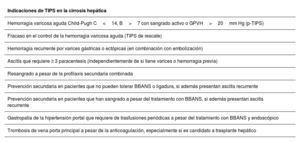
La derivación percutánea portosistémica percutánea o TIPS por sus siglas en inglés, es uno de los tratamientos dentro del arsenal terapéutico para el manejo de las complicaciones de la hipertensión portal. Mediante la creación de una derivación artificial entre la vena porta y una de las venas suprahepáticas, se consigue una reducción rápida de la presión portal y se redirige la mayoría del flujo de sangre procedente de los vasos sanguíneos esplácnicos directamente hacia las cavidades derechas del corazón. Las indicaciones de la TIPS son cada vez más amplias y se ven influidas por el estado general y el pronóstico del paciente. En general, las complicaciones de la hipertensión portal refractarias al tratamiento médico o de difícil control, pese al mismo, como la ascitis refractaria, la hemorragia varicosa recurrente o el hidrotórax hepático son potenciales indicaciones de TIPS. Los avances técnicos han hecho que cada vez se contemplen menos contraindicaciones para esta técnica. En algunos pacientes con trombosis portal compleja, la técnica puede no ser posible, o que para que se complete con éxito requiera la realización de procedimientos de recanalización portal avanzados solo disponibles en centros de referencia. Otras contraindicaciones relativas son la insuficiencia cardíaca congestiva, la hipertensión portopulmonar o la presencia de una infección sistémica activa.

Palabras clave
TIPS
Hipertensión portal
Ascitis
Varices esofágicas
Abstract

Transjugular intrahepatic portosystemic shunting, or TIPS, is one of the treatments in the therapeutic arsenal for managing portal hypertension complications. By creating an artificial shunt between the portal vein and one of the suprahepatic veins, a rapid reduction in portal pressure is achieved and most of the blood flow is redirected from the splanchnic vessels directly to the right chambers of the heart. The indications for TIPS are becoming increasingly broad and are influenced by the patient's general condition and prognosis. In general, complications from portal hypertension that are refractory or difficult to control despite medical treatment, such as refractory ascites, recurrent variceal bleeding, or hepatic hydrothorax, are potential indications for TIPS. Technical advances have led to fewer contraindications to this technique. In some patients with complex portal thrombosis, the technique may not be possible or may require advanced portal vein recanalization procedures only available at reference centers to be successfully completed. Other relative contraindications are congestive heart failure, portopulmonary hypertension, or active systemic infection.

Keywords
TIPS
Portal hypertension
Ascites
Esophageal varices

Identifíquese

¿Aún no es suscriptor de la revista?

Comprar el acceso al artículo

Comprando el artículo el pdf del mismo podrá ser descargado

Teléfono para incidencias

De lunes a viernes de 9h a 18h (GMT+1) excepto los meses de julio y agosto que será de 9 a 15h

Llamadas desde España 932 415 960
Llamadas desde fuera de España +34 932 415 960
Bibliografía
[1]
R. de Franchis
202405310622497938
202405310622497939
, J. Bosch, G. García-Tsao, T. Reiberger, C. Ripoll, J.G. Abraldes, et al.
Baveno VII – Renewing consensus in portal hypertension.
J Hepatol., (2022), 76 pp. 959-974
[2]
S. Rajesh
2024053106224979310
, T. George, C.A. Philips, R. Ahamed, S. Kumbar, N. Mohan, et al.
Transjugular intrahepatic portosystemic shunt in cirrhosis: An exhaustive critical update.
World J Gastroenterol., (2020), 26 pp. 5561-5596
[3]
S. Rajesh
2024053106224979311
, T. George, C.A. Philips, R. Ahamed, S. Kumbar, N. Mohan, et al.
Transjugular intrahepatic portosystemic shunt in cirrhosis: An exhaustive critical update.
World J Gastroenterol., (2020), 26 pp. 5561-5596
[4]
B. Njei
2024053106224979312
, T.R. McCarty, L. Laine.
Early transjugular intrahepatic portosystemic shunt in US patients hospitalized with acute esophageal variceal bleeding.
Journal of Gastroenterology and Hepatology (Australia)., (2017), 32 pp. 852-858
[5]
I.L. Holster
2024053106224979313
2024053106224979314
, E.T. Tjwa, A. Moelker, A. Wils, B.E. Hansen, J.R. Vermeijden, et al.
Covered transjugular intrahepatic portosystemic shunt versus endoscopic therapy+β-blocker for prevention of variceal rebleeding.
Hepatology., (2016), 63 pp. 581-589
[6]
G. García-Tsao
2024053106224979315
2024053106224979316
, J.G. Abraldes, A. Berzigotti, J. Bosch.
Portal hypertensive bleeding in cirrhosis: Risk stratification, diagnosis, and management: 2016 practice guidance by the American Association for the study of liver diseases.
Hepatology., (2017), 65 pp. 310-335
[7]
C. Bureau
2024053106224979317
, D. Thabut, F. Oberti, S. Dharancy, N. Carbonell, A. Bouvier, et al.
Transjugular intrahepatic portosystemic shunts with covered stents increase transplant-free survival of patients with cirrhosis and recurrent ascites.
Gastroenterology., (2017), 152 pp. 157-163
[8]
I.C. Ditah
2024053106224979318
, B.F. Al Bawardy, B. Saberi, C. Ditah, P.S. Kamath.
Transjugular intrahepatic portosystemic stent shunt for medically refractory hepatic hydrothorax: A systematic review and cumulative meta-analysis.
World J Hepatol., (2015), 7 pp. 1797-1806
[9]
M.L. Hung
2024053106224979319
, E.W. Lee.
Role of transjugular intrahepatic portosystemic shunt in the management of portal hypertension: Review and update of the literature.
Clin Liver Dis., (2019), 23 pp. 737-754
[10]
H.L. Lee
2024053106224979320
, S.W. Lee.
The role of transjugular intrahepatic portosystemic shunt in patients with portal hypertension: Advantages and pitfalls.
Clin Mol Hepatol., (2022), 28 pp. 121-134
[11]
L. Téllez
2024053106224979321
2024053106224979322
, A. Guerrero, A. Albillos.
Update on the diagnosis and management of portal hypertension in cirrhosis according to the Baveno VII Consensus Conference recommendations.
Rev Esp Enferm Dig., (2022), 114 pp. 534-542
[12]
C. Billey
2024053106224979323
2024053106224979324
, S. Billet, M.A. Robic, T. Cognet, M. Guillaume, J.P. Vinel, et al.
A prospective study identifying predictive factors of cardiac decompensation after transjugular intrahepatic portosystemic shunt: The Toulouse Algorithm.
Hepatology., (2019), 70 pp. 1928-1941
[13]
L. Téllez
2024053106224979325
, A. Guerrero, A. Albillos Martínez.
Treatment of portal vein thrombosis in cirrhosis patients.
Rev Esp Enferm Dig., (2023), 115 pp. 682-685
[14]
European
2024053106224979326
2024053106224979327
Association for the Study of the Liver.
Electronic address: easloffice@easloffice.eu; European Association for the Study of the Liver. EASL Clinical Practice Guidelines on the management of hepatic encephalopathy.
J Hepatol., (2022), 77 pp. 807-824