

Vol. 14. Núm. 10.
Páginas 574-580 (Mayo 2024)

Protocolos de práctica asistencial
Protocolo de valoración de la fibrosis hepática. Pruebas no invasivas para el diagnóstico de la enfermedad hepática crónica compensada

Assessment protocol for liver fibrosis. Noninvasive tests for diagnosing compensated chronic liver disease

C. Meruéndano PadrónR. Sánchez AldehueloA.B. Agarrabeitia CasadoD. Burgos Santamaría
Doi : https://10.1016/j.med.2024.05.014
Opciones
Resumen

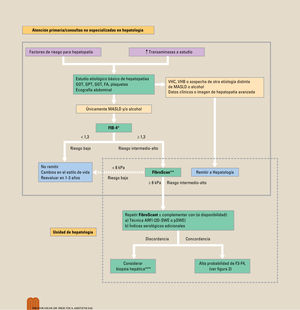
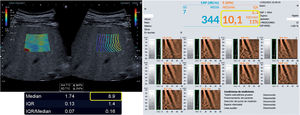
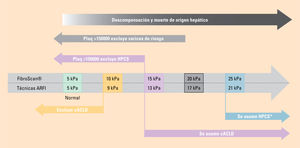
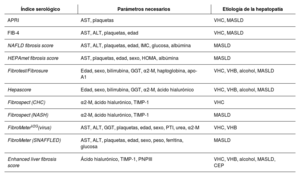
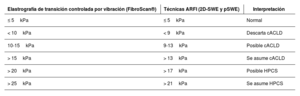
La fibrosis hepática se debe evaluar en toda hepatopatía crónica para adecuar el seguimiento al riesgo individual de morbimortalidad hepática. Los test no invasivos permiten identificar tanto a pacientes sin riesgo de tener fibrosis avanzada como a aquellos con alta probabilidad de padecer hepatopatía crónica avanzada compensada (cACLD). Los índices serológicos simples son accesibles y su uso se recomienda en atención no especializada, donde la prevalencia de la cACLD es baja. Se deben utilizar con el objetivo de descartar cACLD y solo ante factores de riesgo para hepatopatía. Las técnicas elastográficas son más específicas y se emplean en un segundo tiempo para confirmar cACLD. La elastografía de transición es la más validada y se utiliza aplicando una regla de 5 (10-15-20-25kPa), indicando riesgos de descompensación y muerte progresivamente mayores. Las técnicas de impulso por fuerza de radiación acústica cada vez están más extendidas al poder realizarse en el mismo acto que la ecografía.

Palabras clave
Fibrosis
Cirrosis
Elastografía
Índices serológicos
Abstract

Liver fibrosis should be assessed in all cases of chronic liver disease to adjust follow-up to each individual's risk of hepatic morbidity and mortality. Non-invasive tests can identify both patients with no risk of advanced fibrosis and those with a high probability of having compensated advanced chronic liver disease (cACLD). Simple serum-based tests are accessible and their use is recommended in non-specialized care, where the prevalence of cACLD is low. They should be used to rule out cACLD and only when there are risk factors for liver disease. Elastography techniques are more specific and are used to confirm cACLD in a second stage. Vibration-controlled transient elastography is the most validated and follows the rule of 5 (10-15-20-25kPa), indicating progressively higher risks of decompensation and death. Acoustic radiation force impulse techniques are becoming more widespread as they can be performed as abdominal the same time as ultrasound.

Keywords
Fibrosis
Cirrhosis
Elastography
Serological indices

Identifíquese

¿Aún no es suscriptor de la revista?

Comprar el acceso al artículo

Comprando el artículo el pdf del mismo podrá ser descargado

Teléfono para incidencias

De lunes a viernes de 9h a 18h (GMT+1) excepto los meses de julio y agosto que será de 9 a 15h

Llamadas desde España 932 415 960
Llamadas desde fuera de España +34 932 415 960
Bibliografía
[1]
R.de Franchis, Baveno VI Faculty.
Expanding consensus in portal hypertension: Report of the Baveno VI Consensus Workshop: Stratifying risk and individualizing care for portal hypertension.
J Hepatol., (2015), 63 pp. 743-752
[2]
R.de Franchis, J. Bosch, G. García-Tsao, T. Reiberger, C. Ripoll, Baveno VII Faculty.
Baveno VII - Renewing consensus in portal hypertension.
J Hepatol., (2022), 76 pp. 959-974
[3]
J. Neuberger, J. Patel, H. Caldwell, S. Davies, V. Hebditch, C. Hollywood, et al.
Guidelines on the use of liver biopsy in clinical practice from the British Society of Gastroenterology, the Royal College of Radiologists and the Royal College of Pathology.
Gut., (2020), 69 pp. 1382-1403
[4]
European Association for the Study of the Liver.
Electronic address: easloffice@easloffice.eu, Clinical Practice Guideline Panel, Chair, et al. EASL Clinical Practice Guidelines on non-invasive tests for evaluation of liver disease severity and prognosis - 2021 update.
J Hepatol., (2021), 75 pp. 659-689
[5]
J. Boursier, J. Vergniol, A. Guillet, J.B. Hiriart, A. Lannes, B. Le Bail, et al.
Diagnostic accuracy and prognostic significance of blood fibrosis tests and liver stiffness measurement by FibroScan in non-alcoholic fatty liver disease.
J Hepatol., (2016), 65 pp. 570-578
[6]
F.E. Mózes, J.A. Lee, E.A. Selvaraj, A.N.A. Jayaswal, M. Trauner, J. Boursier, et al.
Diagnostic accuracy of non-invasive tests for advanced fibrosis in patients with NAFLD: an individual patient data meta-analysis.
Gut., (2022), 71 pp. 1006-1019
[7]
C. Cassinotto, J. Boursier, A. Paisant, B. Guiu, M. Irles-Depe, C. Canivet, et al.
Transient Versus two-dimensional shear-wave elastography in a multistep strategy to detect advanced fibrosis in NAFLD.
Hepatology., (2021), 73 pp. 2196-2205
[8]
M.E. Rinella, J.V. Lazarus, V. Ratziu, S.M. Francque, A.J. Sanyal, F. Kanwal, et al.
NAFLD Nomenclature consensus group. A multisociety Delphi consensus statement on new fatty liver disease nomenclature.
J Hepatol., (2023), 79 pp. 1542-1556
[9]
B.K. Kim, D.Y. Kim, J.Y. Park, S.H. Ahn, C.Y. Chon, J.K. Kim, et al.
Validation of FIB-4 and comparison with other simple noninvasive indices for predicting liver fibrosis and cirrhosis in hepatitis B virus-infected patients.
Liver Int., (2010), 30 pp. 546-553
[10]
S. McPherson, S.F. Stewart, E. Henderson, A.D. Burt, C.P. Day.
Simple non-invasive fibrosis scoring systems can reliably exclude advanced fibrosis in patients with non-alcoholic fatty liver disease.
Gut., (2010), 59 pp. 1265-1269
[11]
P. Angulo, J.M. Hui, G. Marchesini, E. Bugianesi, J. George, G.C. Farrell, et al.
The NAFLD fibrosis score: a noninvasive system that identifies liver fibrosis in patients with NAFLD.
Hepatology., (2007), 45 pp. 846-854
[12]
R. Younes, G.P. Caviglia, O. Govaere, C. Rosso, A. Armandi, T. Sanavia, et al.
Long-term outcomes and predictive ability of non-invasive scoring systems in patients with non-alcoholic fatty liver disease.
J Hepatol., (2021), 75 pp. 786-794
[13]
S. McPherson, T. Hardy, J.-F. Dufour, S. Petta, M. Romero-Gomez, M. Allison, et al.
Age as a confounding factor for the accurate non-invasive diagnosis of advanced NAFLD fibrosis.
Am J Gastroenterol., (2017), 112 pp. 740-751
[14]
J. Ampuero, R. Pais, R. Aller, R. Gallego-Durán, J. Crespo, C. García-Monzón, et al.
Development and validation of hepamet fibrosis scoring system-a simple, noninvasive test to identify patients with nonalcoholic fatty liver disease with advanced fibrosis.
Clin Gastroenterol Hepatol., (2020), 18
[15]
P.J. Eddowes, M. Sasso, M. Allison, E. Tsochatzis, Q.M. Anstee, D. Sheridan, et al.
Accuracy of FibroScan controlled attenuation parameter and liver stiffness measurement in assessing steatosis and fibrosis in patients with nonalcoholic fatty liver disease.
Gastroenterology., (2019), 156 pp. 1717-1730
[16]
R.G. Barr, S.R. Wilson, D. Rubens, G. Garcia-Tsao, G. Ferraioli.
Update to the Society of Radiologists in Ultrasound Liver Elastography Consensus Statement.
Radiology., (2020), 296 pp. 263-274
[17]
R. Loomba, L.A. Adams.
Advances in non-invasive assessment of hepatic fibrosis.
Gut., (2020), 69 pp. 1343-1352
[18]
P. Bedossa, C. Poitou, N. Veyrie, J.L. Bouillot, A. Basdevant, V. Paradis, et al.
Histopathological algorithm and scoring system for evaluation of liver lesions in morbidly obese patients.
Hepatology., (2012), 56 pp. 1751-1759
[19]
D.E. Kleiner, E.M. Brunt, M. Van Natta, C. Behling, M.J. Contos, O.W. Cummings, et al.
Design and validation of a histological scoring system for nonalcoholic fatty liver disease.
Hepatology., (2005), 41 pp. 1313-1321
[20]
K. Ishak, A. Baptista, L. Bianchi, F. Callea, J. De Groote, F. Gudat, et al.
Histological grading and staging of chronic hepatitis.
J Hepatol., (1995), 22 pp. 696-699
[21]
P. Bedossa, T. Poynard.
An algorithm for the grading of activity in chronic hepatitis C.
Hepatology., (1996), 24 pp. 289-293