

Vol. 14. Núm. 11.
Páginas 622-626 (Mayo 2024)

Protocolos de práctica asistencial
Protocolo diagnóstico de la fiebre y la hipertransaminasemia en el paciente inmunocompetente

Diagnostic protocol for fever and hypertransaminasemia in immunocompetent patients

E.C. Abad IzquierdoJ. CaoM. López GómezJ.L. Calleja Panero
Doi : https://10.1016/j.med.2024.05.023
Opciones
Resumen

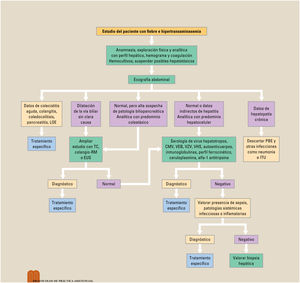
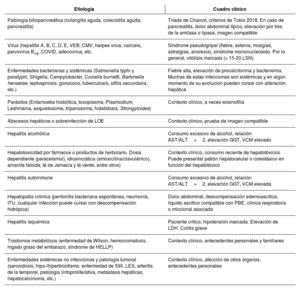
Ante un paciente inmunocompetente con fiebre e hipertransaminasemia se debe realizar un diagnóstico diferencial con las infecciones y las enfermedades propias del hígado, hepatopatía crónica avanzada, patología biliopancreática, sepsis y procesos sistémicos o extrahepáticos de tipo inflamatorio, tumoral o infeccioso. El estudio del paciente debe incluir una anamnesis completa, exploración física, analítica sanguínea y una prueba de imagen que, por lo general, suele ser una ecografía abdominal. Si la sospecha diagnóstica es de hepatitis aguda, debe estudiarse la presencia de virus hepatotropos, tóxicos y autoanticuerpos. En caso de no llegar a un diagnóstico, se deberá reevaluar el caso para dirigir el diagnóstico hacia patologías menos frecuentes e incluso realizar una biopsia hepática.

Palabras clave
Hipertransaminasemia
Fiebre
Diagnóstico
Abstract

In immunocompetent patients with fever and hypertransaminasemia, a differential diagnosis must be made among liver infections and diseases; advanced chronic liver disease; biliopancreatic diseases; sepsis; and systemic or extrahepatic inflammatory, tumor, or infectious diseases. Studies of the patient should include a comprehensive case history, physical examination, blood test, and imaging test, which is usually an abdominal ultrasound. If the diagnostic suspicion is acute hepatitis, the presence of hepatotropic viruses, toxins, and autoantibodies should be studied. In case of failure to reach a diagnosis, the case should be reevaluated to orient the diagnosis toward less frequent diseases and a liver biopsy may even be performed.

Keywords
Hypertransaminasemia
Fever
Diagnosis

Identifíquese

¿Aún no es suscriptor de la revista?

Comprar el acceso al artículo

Comprando el artículo el pdf del mismo podrá ser descargado

Teléfono para incidencias

De lunes a viernes de 9h a 18h (GMT+1) excepto los meses de julio y agosto que será de 9 a 15h

Llamadas desde España 932 415 960
Llamadas desde fuera de España +34 932 415 960
Bibliografía recomendada
[1]
EASL
202406051216440758
202406051216440759
Clinical Practice Guidelines for the management of patients with decompensated cirrhosis. J Hepatol. 2018; 69(2):406-60.
[2]
EASL
2024060512164407510
2024060512164407511
Clinical Practice Guidelines: Drug-induced liver injury. J Hepatol. 2019; 60(2):282-330.
[3]
European
2024060512164407512
2024060512164407513
Association for the Study of the Liver.
EASL Clinical Practice Guidelines on the management of acute (fulminant) liver failure.
J Hepatol., (2017), 66 pp. 1047-1081
[4]
European
2024060512164407514
2024060512164407515
Association for the Study of the Liver.
EASL Clinical Practice Guidelines: management of alcohol-related liver disease.
J Hepatol., (2018), 69 pp. 154-181
[5]
Friedman
2024060512164407516
2024060512164407517
LS. Approach to the patient with abnormal liver biochemical and function tests. UpToDate, Connor RF, editor. Wolters Kluwer. Disponible en: www.uptodate.com [Consultado 8 Nov 2023].
[6]
R.M. Gálvez Fernández
2024060512164407518
2024060512164407519
, J.M. Rosales Zábal, M.C. García Gavilán.
Afectación hepática de origen infeccioso no relacionado con virus hepatotropos.
RAPD Online., (2020), 43 pp. 9-18
[7]
Goldberg
2024060512164407520
2024060512164407521
E, Chopra S, Rubin JN. Acute liver failure in adults: Etiology, clinical manifestations, and diagnosis. UpToDate. Connor RF, editor. Wolters Kluwer. Disponible en: www.uptodate.com. [Consultado 8 Nov 2023].
[8]
S. Kiriyama
2024060512164407522
2024060512164407523
, K. Kozaka, T. Takada, S.M. Strasberg, H.A. Pitt, T. Gabata, et al.
Tokyo Guidelines 2018: diagnostic criteria and severity grading of acute cholangitis (with videos).
J Hepatobiliary Pancreat Sci., (2018), 25 pp. 17-30
[9]
M.P.G. Martínez
2024060512164407524
2024060512164407525
, A.J.G. Imbroda.
Protocolo diagnóstico de hipertransaminasemia y fiebre.
Medicine., (2018), 12 pp. 3492-3496
[10]
P.N. Newsome
2024060512164407526
2024060512164407527
, R. Cramb, S.M. Davison, J.F. Dillon, M. Foulerton, E.M. Godfrey, et al.
Guidelines on the management of abnormal liver blood tests.