

Vol. 14. Núm. 7.
Páginas 379-391 (Abril 2024)

Actualización
Enfermedades inflamatorias de páncreas y vía biliar

Inflammatory diseases of the pancreas and bile duct

M. Bragado PascualF. Aguilera GarcíaA. Hernando AlonsoF. Bighelli
Doi : https://10.1016/j.med.2024.04.007
Opciones
Resumen

La afectación inflamatoria de vía biliar y del páncreas puede presentarse de maneras diferentes dependiendo de la etiología y del lugar de afectación. Se trata de enfermedades raras, siendo la más frecuente la pancreatitis autoinmune que presenta dos subtipos; el tipo 1, que se considera la manifestación pancreática de la enfermedad sistémica por IgG4 (IgG4-RD), y el tipo 2 que se considera una patología primariamente pancreática. La presentación clínica más frecuente es en forma de ictericia y masas pancreáticas con o sin dolor abdominal, planteando el diagnóstico diferencial con el adenocarcinoma de páncreas. El tratamiento se basa en los corticoides, con buenas tasas de respuesta, pero con un riesgo no desdeñable de recidiva, llegando a precisar a veces un tratamiento con anti-CD20 (rituximab) o inmunosupresores. La IgG4-RD puede afectar también a la vía biliar, en cuyo caso se denomina colangitis esclerosante por IgG4, y de manera parecida el tratamiento se basa en corticoides. Por último, la colangitis piogénica recurrente es un tipo de enfermedad inflamatoria de la vía biliar poco frecuente, caracterizada por la formación de litiasis de repetición en la vía biliar tanto intrahepática como extrahepática y episodios recurrentes de colangitis que precisan a menudo tratamientos endoscópicos, radiológicos o quirúrgicos además del tratamiento médico.

Palabras clave
Pancreatitis autoinmune
IgG4
Colangitis esclerosante IgG4
Colangitis piogénica recurrente
Abstract

Inflammatory involvement of the bile duct and pancreas can present in different ways depending on the etiology and place of involvement. These are rare diseases; the most common is autoimmune pancreatitis, which has two subtypes: type 1, which is considered the pancreatic manifestation of systemic IgG4-related disease (IgG4-RD) and type 2, which is considered a primarily pancreatic disease. The most common clinical presentation is in the form of jaundice and pancreatic masses with or without abdominal pain, which necessitates a differential diagnosis with pancreatic adenocarcinoma. Treatment is based on corticosteroids, with good response rates, but there is a non-negligible risk of recurrence which sometimes requires treatment with anti-CD20 (rituximab) or immunosuppressants. IgG4-RD can also affect the bile duct, in which case it is called IgG4-related sclerosing cholangitis, and treatment is similarly based on corticosteroids. Lastly, recurrent pyogenic cholangitis is a rare type of inflammatory disease of the bile duct characterized by the formation of recurrent intrahepatic and extrahepatic bile duct stones and recurrent episodes of cholangitis that often require endoscopic, radiological, or surgical treatment in addition to medical treatment.

Keywords
Autoimmune pancreatitis
IgG4
IgG4-related sclerosing cholangitis
Recurrent pyogenic cholangitis

Identifíquese

¿Aún no es suscriptor de la revista?

Comprar el acceso al artículo

Comprando el artículo el pdf del mismo podrá ser descargado

Teléfono para incidencias

De lunes a viernes de 9h a 18h (GMT+1) excepto los meses de julio y agosto que será de 9 a 15h

Llamadas desde España 932 415 960
Llamadas desde fuera de España +34 932 415 960
Bibliografía
[1]
T. Shimosegawa
202404150548277078
202404150548277079
, S.T. Chari, L. Frulloni, T. Kamisawa, S. Kawa, M. Mino-Kenudson, et al.
International consensus diagnostic criteria for autoimmune pancreatitis: Guidelines of the international association of pancreatology.
Pancreas., (2011), 40 pp. 352-358
[2]
N. de Pretis
2024041505482770710
, F. Vieceli, A. Brandolese, L. Brozzi, A. Amodio, L. Frulloni.
Autoimmune pancreatitis not otherwise specified (NOS): Clinical features and outcomes of the forgotten type.
Hepatobiliary & Pancreatic Diseases International, (2019), 18 pp. 576-579
[3]
A. Kanno
2024041505482770711
, I. Nishimori, A. Masamune, K. Kikuta, M. Hirota, S. Kuriyama, et al.
Nationwide epidemiological survey of autoimmune pancreatitis in Japan.
Pancreas., (2012), 41 pp. 835-839
[4]
N. De Pretis
2024041505482770712
, L. Frulloni.
Autoimmune pancreatitis type 2.
Curr Opin Gastroenterol., (2020), 36 pp. 417-420
[5]
R. Sánchez-Oro
2024041505482770713
, E.M. Alonso-Muñoz, L. Martí Romero.
Revisión de la enfermedad relacionada con la IgG4.
Gastroenterol Hepatol., (2019), 42 pp. 638-647
[6]
T. Yoshikawa
2024041505482770714
, T. Watanabe, K. Kamata, A. Hara, K. Minaga, M. Kudo.
Intestinal dysbiosis and autoimmune pancreatitis.
Front Immunol., (2021), 12 pp. 621532
[7]
N. Ishiguro, M. Moriyama, K. Furusho, S. Furukawa, T. Shibata, Y. Murakami, et al.
Activated M2 macrophages contribute to the pathogenesis of igg4-related disease via toll-like receptor 7/interleukin-33 signaling.
Arthritis Rheumatol., (2020), 72 pp. 166-178
[8]
H. Mattoo, E. Della-Torre, V.S. Mahajan, J.H. Stone, S. Pillai.
Circulating Th2 memory cells in IgG4-related disease are restricted to a defined subset of subjects with atopy.
Allergy., (2014), 69 pp. 399-402
[9]
A.M. Davies
2024041505482770715
, B.J. Sutton.
Human IgG4: a structural perspective.
Immunol Rev., (2015), 268 pp. 139-159
[10]
M. Shiokawa, Y. Kodama, K. Kuriyama, K. Yoshimura, T. Tomono, T. Morita, et al.
Pathogenicity of IgG in patients with IgG4-related disease.
Gut., (2016), 65 pp. 1322-1332
[11]
G. Katz
2024041505482770716
, J.H. Stone.
Clinical perspectives on IgG4-related disease and its classification.
Annu Rev Med., (2022), 73 pp. 545-562
[12]
Y. Zen
2024041505482770717
.
Type 2 autoimmune pancreatitis: Consensus and controversies.
Gut Liver., (2022), 16 pp. 357-365
[13]
D.S. Pearl
2024041505482770718
, K. Shah, M.A. Whittaker, H. Nitch-Smith, J.F. Brown, J.K. Shute, et al.
Cytokine mucosal expression in ulcerative colitis, the relationship between cytokine release and disease activity.
J Crohns Colitis., (2013), 7 pp. 481-489
[14]
M. Loos
2024041505482770719
, F. Lauffer, A.M. Schlitter, J. Kleeff, H. Friess, G. Klöppel, et al.
Potential role of Th17 cells in the pathogenesis of type 2 autoimmune pancreatitis.
Virchows Arch., (2015), 467 pp. 641-648
[15]
J.F. Zambrano-Zaragoza
2024041505482770720
, E.J. Romo-Martínez, M.de J. Durán-Avelar, N. García-Magallanes, N. Vibanco-Pérez.
Th17 cells in autoimmune and infectious diseases.
Int J Inflam., (2014), 2014 pp. 651503
[16]
R. Gupta
2024041505482770721
, A. Neyaz, A. Chougule, M. Akita, Y. Zen, D. Forcione, et al.
Autoimmune pancreatitis type 2: Diagnostic utility of PD-L1 immunohistochemistry.
Am J Surg Pathol., (2019), 43 pp. 898-906
[17]
H. Van Buuren, F. Vleggaar, G. Willemien Erkelens, P.E. Zondervan, W. Lesterhuis, C.H. Van Eijck, et al.
Autoimmune pancreatocholangitis: A series of ten patients.
Scand J Gastroenterol., (2006), 41Suppl243 pp. 70-78
[18]
H. Umehara
2024041505482770722
, K. Okazaki, Y. Masaki, M. Kawano, M. Yamamoto, T. Saeki, et al.
Comprehensive diagnostic criteria for IgG4-related disease (IgG4-RD), 2011.
Mod Rheumatol., (2012), 22 pp. 21-30
[19]
J.M. Löhr
2024041505482770723
2024041505482770724
, U. Beuers, M. Vujasinovic, D. Alvaro, J.B. Frøkjær, F. Buttgereit, et al.
European Guideline on IgG4-related digestive disease – UEG and SGF evidence-based recommendations.
United European Gastroenterol J., (2020), 8 pp. 637
[20]
C. Rehnitz
2024041505482770725
, M. Klauss, R. Singer, R. Ehehalt, J. Werner, M.W. Büchler, et al.
Morphologic patterns of autoimmune pancreatitis in CT and MRI.
Pancreatology., (2011), 11 pp. 240-251
[21]
Diagnóstico
2024041505482770726
2024041505482770727
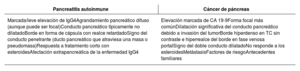
diferencial entre compromiso pancreático en enfermedad relacionada con IgG4 y cáncer de páncreas [Consultado 19 Oct 2023]. Disponible en: https://www.elsevier.es/es-revista-gastroenterologia-hepatologia-14-pdf-S0210570520302521.
[22]
A. Khosroshahi
2024041505482770728
, J.H. Stone.
A clinical overview of IgG4-related systemic disease.
Curr Opin Rheumatol., (2011), 23 pp. 57-66
[23]
T. Kamisawa
2024041505482770729
, H. Ohara, M.H. Kim, A. Kanno, K. Okazaki, N. Fujita.
Role of endoscopy in the diagnosis of autoimmune pancreatitis and immunoglobulin G4-related sclerosing cholangitis.
Digestive Endoscopy., (2014), 26 pp. 627-635
[24]
S.B. Yoon
2024041505482770730
, S.H. Moon, T.J. Song, J.H. Kim, M.H. Kim.
Endoscopic ultrasound-guided fine needle aspiration versus biopsy for diagnosis of autoimmune pancreatitis: Systematic review and comparative meta-analysis.
Dig Endosc., (2021), 33 pp. 1024-1033
[25]
K. Okazaki
2024041505482770731
2024041505482770732
, S.T. Chari, L. Frulloni, M.M. Lerch, T. Kamisawa, S. Kawa, et al.
International consensus for the treatment of autoimmune pancreatitis.
Pancreatology., (2017), 17 pp. 1-6
[26]
H.M. Kim
2024041505482770733
, M.J. Chung, J.B. Chung.
Remission and relapse of autoimmune pancreatitis: Focusing on corticosteroid treatment.
Pancreas., (2010), 39 pp. 555-560
[27]
P. Brito-Zerón
2024041505482770734
, B. Kostov, X. Bosch, N. Acar-Denizli, M. Ramos-Casals, J.H. Stone.
Therapeutic approach to IgG4-related disease: A systematic review.
[28]
S. Nikolic
2024041505482770735
, N. Panic, E.S. Hintikka, L. Dani, W. Rutkowski, A. Hedström, et al.
Efficacy and safety of rituximab in autoimmune pancreatitis type 1: our experiences and systematic review of the literature.
Scand J Gastroenterol., (2021), 56 pp. 1355-1362
[29]
P.A. Hart
2024041505482770736
, M.D. Topazian, T.E. Witzig, J.E. Clain, F.C. Gleeson, R.R. Klebig, et al.
Treatment of relapsing autoimmune pancreatitis with immunomodulators and rituximab: the Mayo Clinic experience.
Gut., (2013), 62 pp. 1607-1615
[30]
J. Backhus, C. Neumann, L. Perkhofer, L.A. Schulte, B. Mayer, T. Seufferlein, et al.
A follow-up study of a european IgG4-related disease cohort treated with rituximab.
J Clin Med., (2021), 10 pp. 1329
[31]
M. Tacelli
2024041505482770737
, C. Celsa, B. Magro, L. Barresi, S. Guastella, G. Capurso, et al.
Risk factors for rate of relapse and effects of steroid maintenance therapy in patients with autoimmune pancreatitis: Systematic review and meta-analysis.
Clin Gastroenterol Hepatol., (2019), 17
[32]
P.A. Hart, T. Kamisawa, W.R. Brugge, J.B. Chung, E.L. Culver, L. Czakó, et al.
Long-term outcomes of autoimmune pancreatitis: a multicentre, international analysis.
Gut., (2013), 62 pp. 1771-1776
[33]
M. Naghibi
2024041505482770738
, A. Ahmed, A.M. al Badri, A.C. Bateman, H.A. Shepherd, J.N. Gordon.
The successful treatment of IgG4-positive colitis with adalimumab in a patient with IgG4-related sclerosing disease - a new subtype of aggressive colitis?.
[34]
K. Hirano, M. Tada, N. Sasahira, H. Isayama, S. Mizuno, K. Takagi, et al.
Incidence of malignancies in patients with IgG4-related disease.
Inter Med., (2014), 53 pp. 171-176
[35]
A. Martínez-de-Alegría
2024041505482770739
, S. Baleato-González, R. García-Figueiras, A. Bermúdez-Naveira, I. Abdulkader-Nallib, J.A. Díaz-Peromingo, et al.
IgG4-related disease from head to toe.
Radiographics., (2015), 35 pp. 2007-2025
[36]
M. Takasumi, M. Miyata, M. Kuroda, K. Terashima, K. Abe, A. Takahashi, et al.
Overlap of IgG4-related disease and primary biliary cirrhosis complicated with autoimmune thrombocytopenia.
Intern Med., (2016), 55 pp. 1387-1392
[37]
S. Arikawa
2024041505482770740
, M. Uchida, Y. Kunou, J. Uozumi, T. Abe, N. Hayabuchi, et al.
Comparison of sclerosing cholangitis with autoimmune pancreatitis and infi ltrative extrahepatic cholangiocarcinoma: Multidetector-row computed tomography fi ndings.
Jpn J Radiol., (2010), 28 pp. 205-213
[38]
Y. Zen
2024041505482770741
, Y. Nakanuma, B. Portmann.
Immunoglobulin G4-related sclerosing cholangitis: pathologic features and histologic mimics.
Semin Diagn Pathol., (2012), 29 pp. 205-211
[39]
W.M.S. Tsui
2024041505482770742
, P.W.Y. Lam, W.K. Lee, Y.K. Chan.
Primary hepatolithiasis, recurrent pyogenic cholangitis, and oriental cholangiohepatitis - A tale of 3 countries.
Adv Anat Pathol., (2011), 18 pp. 318-328
[40]
J.H. Lim
2024041505482770743
2024041505482770744
, J.H. Lim.
Oriental cholangiohepatitis: pathologic, clinical, and radiologic features, (2013), 157 pp. 1-8